Tiezheng gantry machining centers are reviewed for large metal parts that need a wider work envelope, stable fixture planning and project-specific spindle or tooling selection. Buyers should match each MB, DK, DA or related gantry model to drawings, material, weight, loading method and acceptance criteria before requesting a quote.
Large-part milling, drilling, tapping, boring and fixture-based CNC machining review. Final route depends on the selected gantry model, tooling, workholding and workpiece drawing.
Workpieces
Large plates, machine bases, molds, frames, structural parts and oversized metal components that need a gantry-style work envelope after drawing review.
Materials
Project-specific steel, cast iron, aluminum, alloy or mixed metal materials. Confirm material grade, blank condition and cutting allowance during RFQ.
Capacity
Model-specific. Select the gantry machine by work envelope, table load, bridge clearance, spindle/tooling needs, fixture height and acceptance criteria after engineering review.
Spindle / power
Model-specific spindle, head and tool configuration. Confirm spindle taper, speed range, tool capacity, cutting force and service requirements before quotation.
Axis / stations
Gantry machining center configuration. Optional head, fixture or rotary-axis review depends on the selected model and workpiece.
Automation
fixture-system
Control system
Project-specific CNC control configuration. Confirm controller preference, service requirements and destination-market expectations during RFQ.
Tiezheng gantry machining centers are reviewed when a part and fixture need a larger supported area or a different loading and spindle-access arrangement. Compare table dimensions, X/Y/Z travels, table load and clearance separately on each model page. Check the full setup and load distribution before choosing a route; table size is not a guaranteed usable cutting envelope.
When is a gantry machining center worth reviewing?
Review plates, frames, bases, molds and other large-part geometries where milling, drilling or boring access requires this layout. These examples do not establish material, accuracy or load suitability. Compare the complete part-and-fixture mass, loading access, crossbeam clearance and tool assembly with the proposed configuration.
What should I check before choosing a model?
Read each model’s published dimensions, axis travels, workpiece limits and load ratings separately. Check the complete part, fixture, tool assembly and clearances. These values are not a guarantee that all limits can be used simultaneously. Confirm the control, spindle, tooling and standard or optional equipment for the supplied configuration.
How should I use the machine images and specifications?
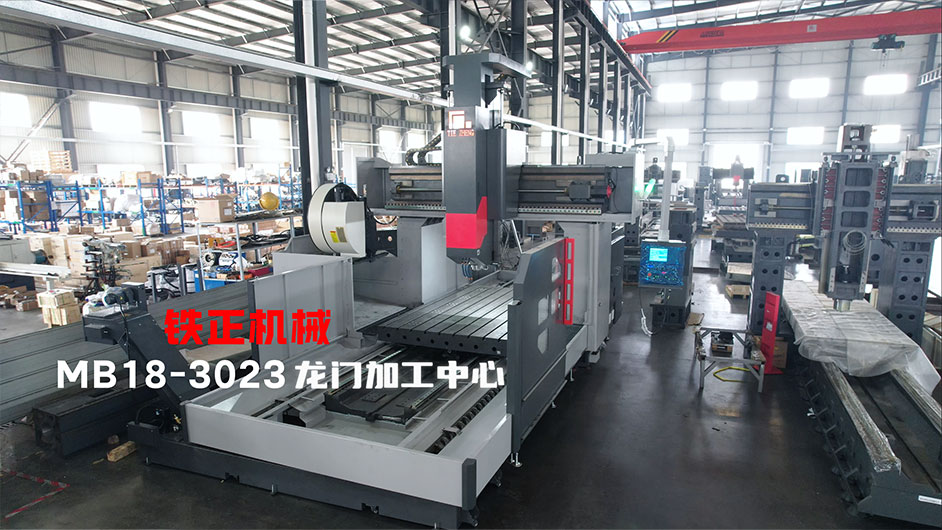
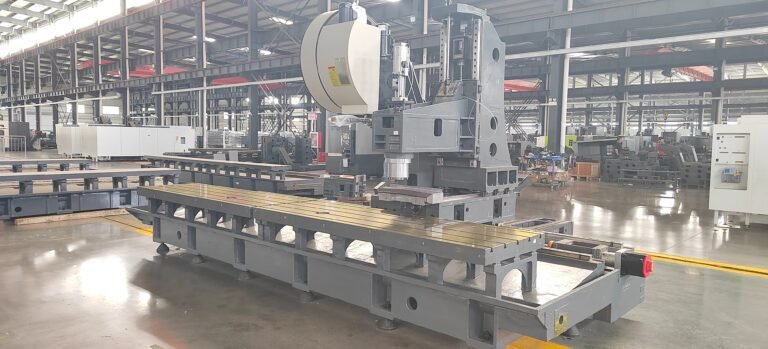
Images show the machine form and workshop context. They do not establish finished-part accuracy, cycle time, material suitability or certificate coverage. Open the exact model’s specification table to check labels, units and configuration notes. Ask the listed contact for any missing value; an omitted value is not zero.
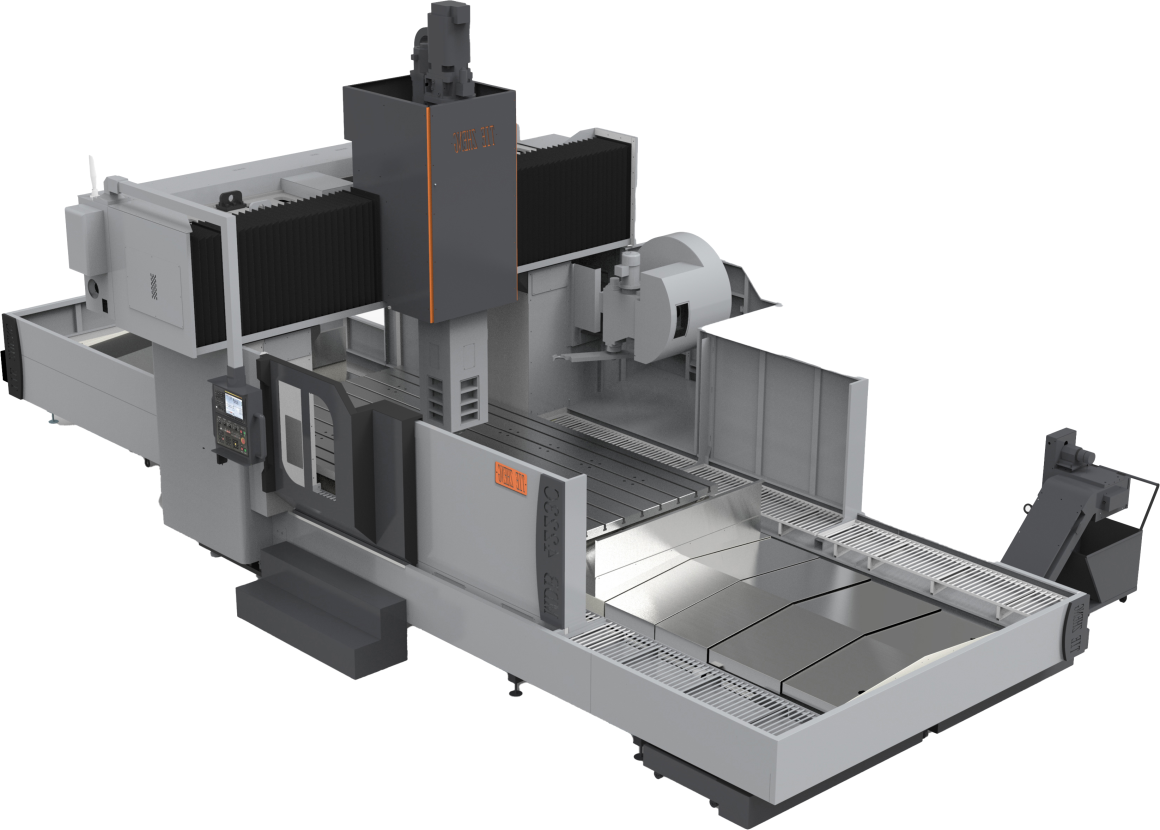
Configuration illustration, not a photograph of this exact model. Confirm the supplied equipment with your sales contact.
What information helps your contact review the application?
The operations and faces to be machined, with part dimensions and total part-and-fixture weight if known.
Material grade, blank condition, critical tolerances, surface requirements and the proposed inspection method.
Workholding concept, tool access, loading method, production quantity and any target cycle time.
Destination country, control preference, utilities and installation or training requirements.
A model choice and drawing are optional at first contact. Describe the part or operation you know. Agree a suitable channel for confidential drawings directly with your representative. Configuration, delivery, acceptance and the formal quotation are confirmed by that contact, not automatically by this website.
How are documentation and service confirmed?
Certificate resources support document review; they are not blanket approval for every model, option or destination. Confirm the exact model, certificate scope and destination-market requirements. Installation, training, spare parts, inspection and support responsibilities must be agreed for the order.
Does the largest published dimension prove that my part fits?
No. Review the complete part, fixture, tools, axis movements, loading access and clearances together. Separate maximum values are not a combined machining envelope.
Can I select a material or industry and treat the result as approved?
No. Those inputs describe the intended work. Material grade, cutting plan, required accuracy and production conditions need individual review; a category label is not qualification for an industry.
Is automation or driven tooling always included?
No. Confirm the exact equipment, interfaces, guarding and standard or optional scope for the model and order.
Can I ask a question without a model or drawing?
Yes. Start with your part or operation. Your contact can identify the information needed for a configuration discussion and confirm the quotation directly.
Which gantry models and videos can buyers review first?
Watch the videos below to compare model layout, workshop handling and installation activity. Final capability depends on the selected configuration and workpiece drawing.
Compare axis travel, table dimensions and table load separately. A table dimension is not a guaranteed cutting envelope. Include the complete part, fixture, tool assembly and load distribution when reviewing the published limits. Where a value is omitted, ask the contact for this exact model rather than borrowing a value from a neighbouring machine.
On a narrow screen, scroll the table horizontally. Select the table with Tab and use the left and right arrow keys.
How do these gantry models compare?
Specification
SFA/T2012
MB22-8030
X-axis travel
2100 mm
8200 mm
Y-axis travel
1200 mm
3000 mm
Z-axis travel
550 mm
1000 mm
Worktable dimensions
2000 × 1200 mm
Please confirm with the contact
Worktable load
Please confirm with the contact
25 t
These are separate limits, not a guaranteed simultaneous workpiece envelope. A model and drawing are optional for the first inquiry. The contact confirms the final configuration, delivery and quotation directly.
Compare the models below using their specifications, product photos and videos. Confirm the final configuration against your part drawing and production requirements.
Technical specifications. Open the model page for the complete table and chart.
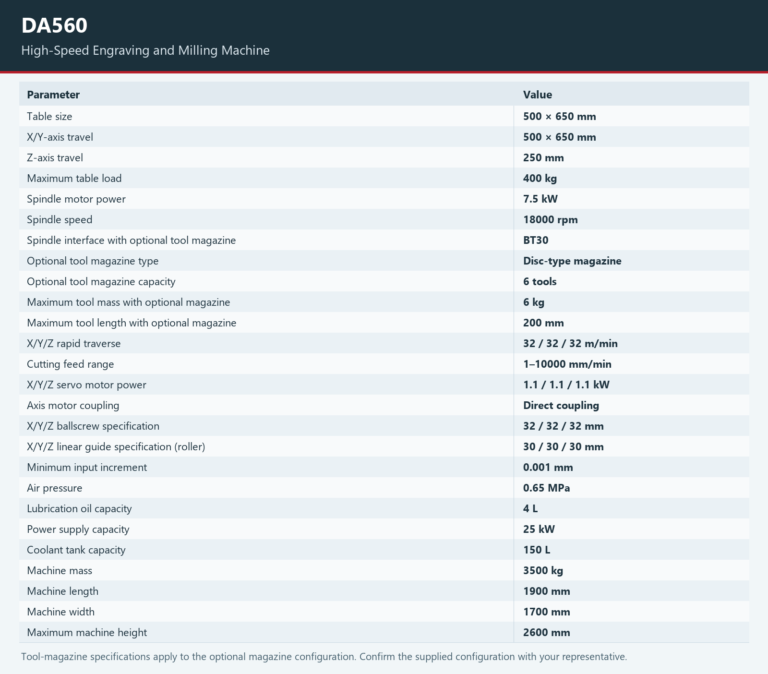
DA560 is a high-speed engraving and milling machine with a 500 × 650 mm table, 500 × 650 × 250 mm X/Y/Z-axis travels and a stated maximum table load of 400 kg. The spindle speed is
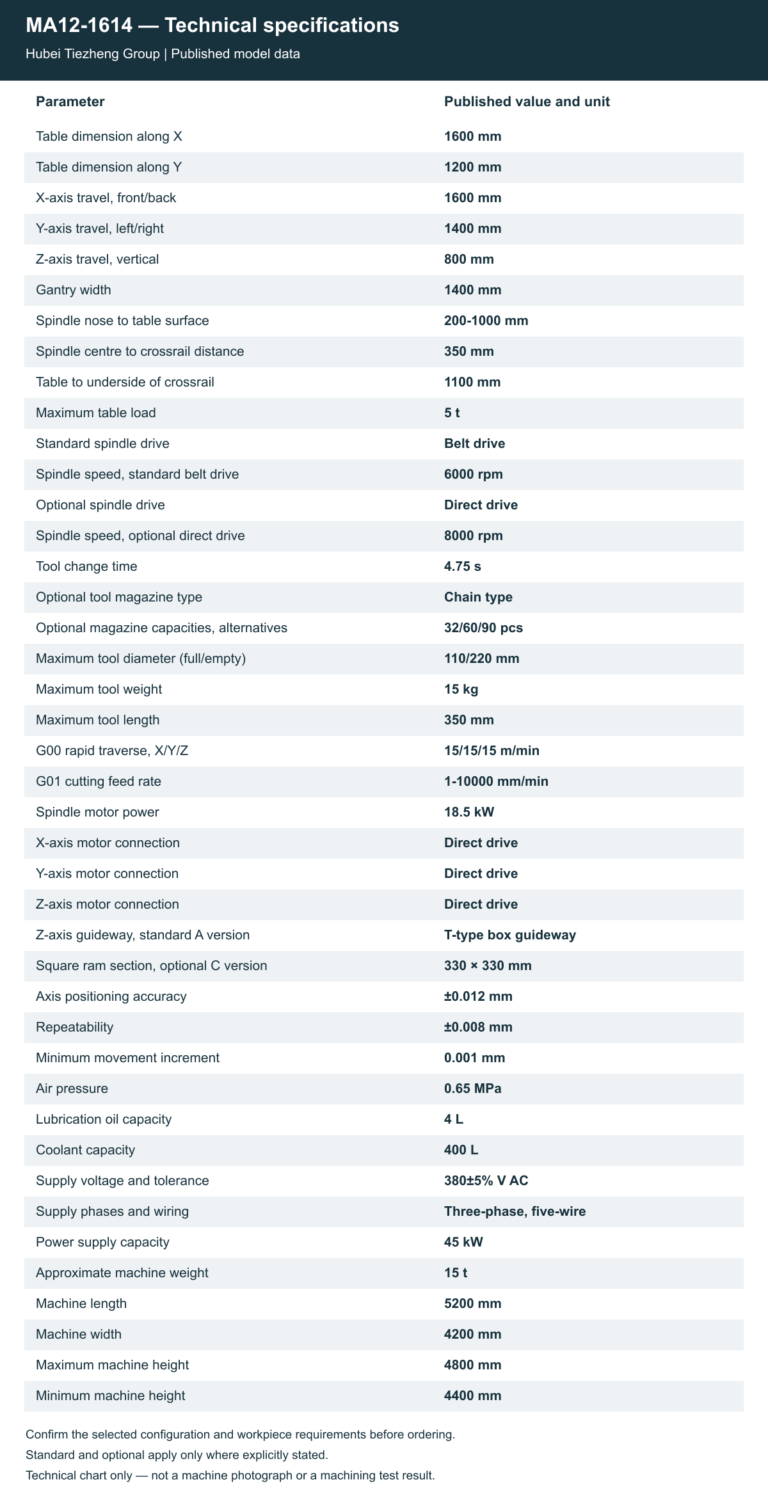
The MA12-1614 is listed under gantry machining centers in the Tiezheng catalogue. Table dimension along X: 1600 mm; Table dimension along Y: 1200 mm. Published dimensions and spindle data do not approve a workpiece setup. Compare
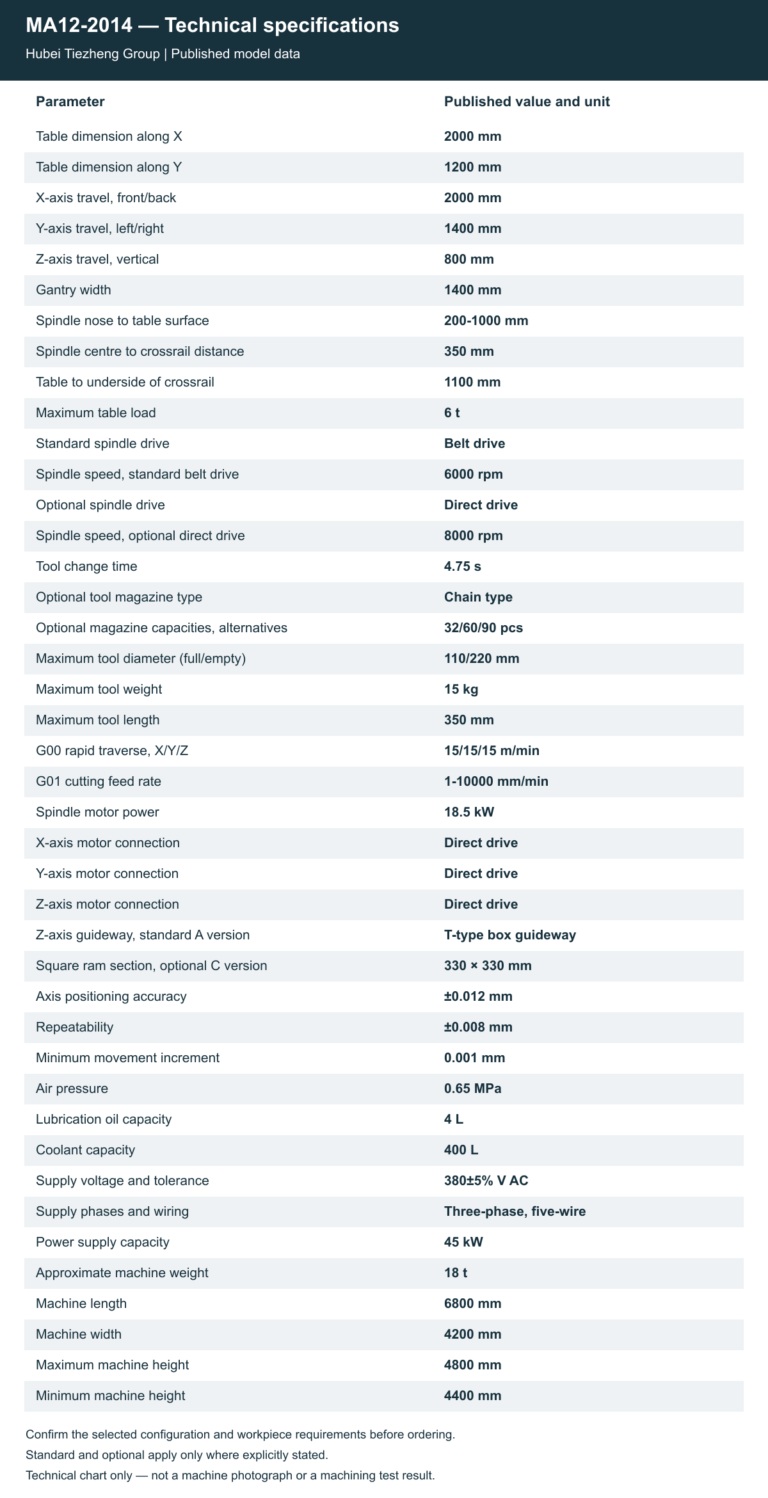
The MA12-2014 is listed under gantry machining centers in the Tiezheng catalogue. Table dimension along X: 2000 mm; Table dimension along Y: 1200 mm. Published dimensions and spindle data do not approve a workpiece setup. Compare
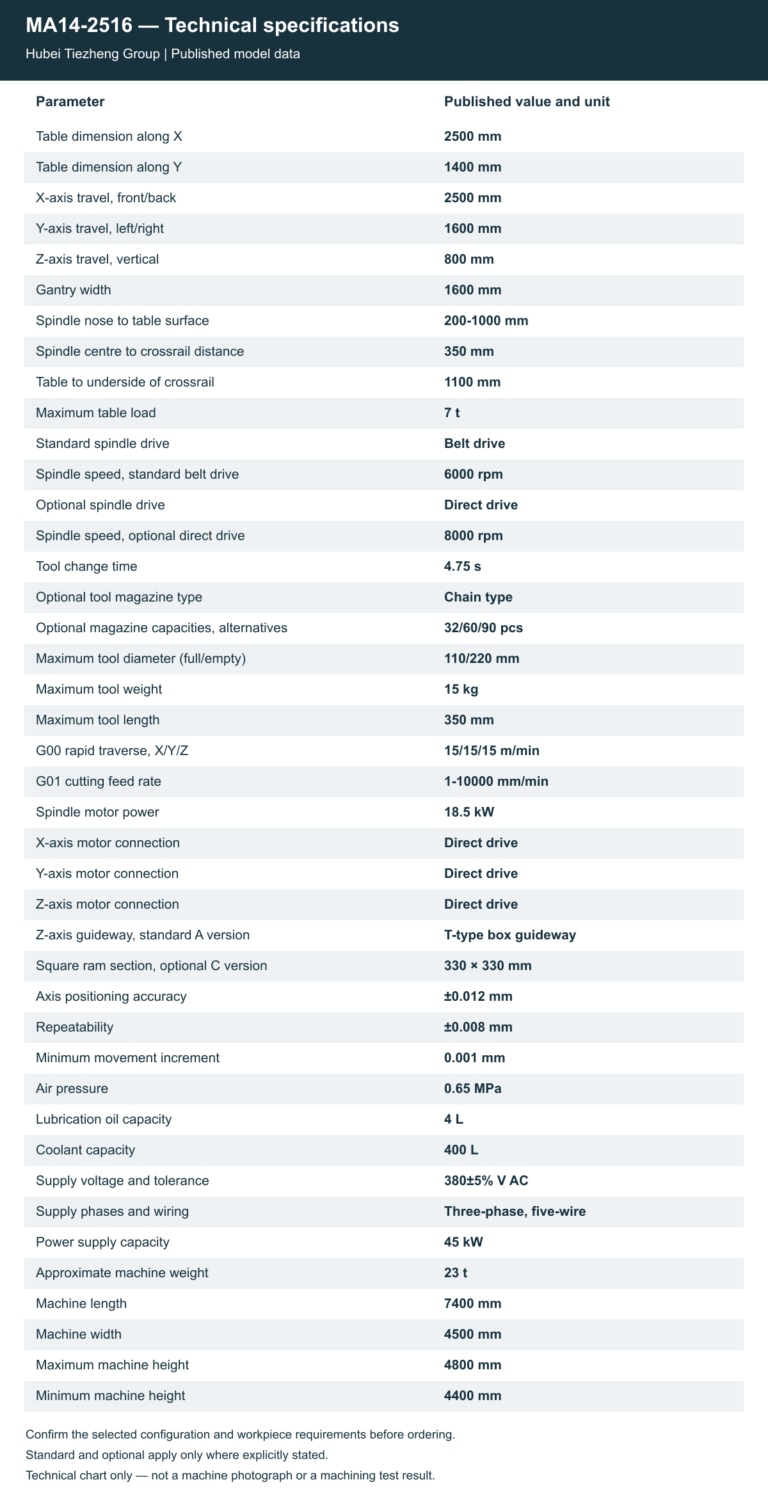
The MA14-2516 is listed under gantry machining centers in the Tiezheng catalogue. Table dimension along X: 2500 mm; Table dimension along Y: 1400 mm. Published dimensions and spindle data do not approve a workpiece setup. Compare
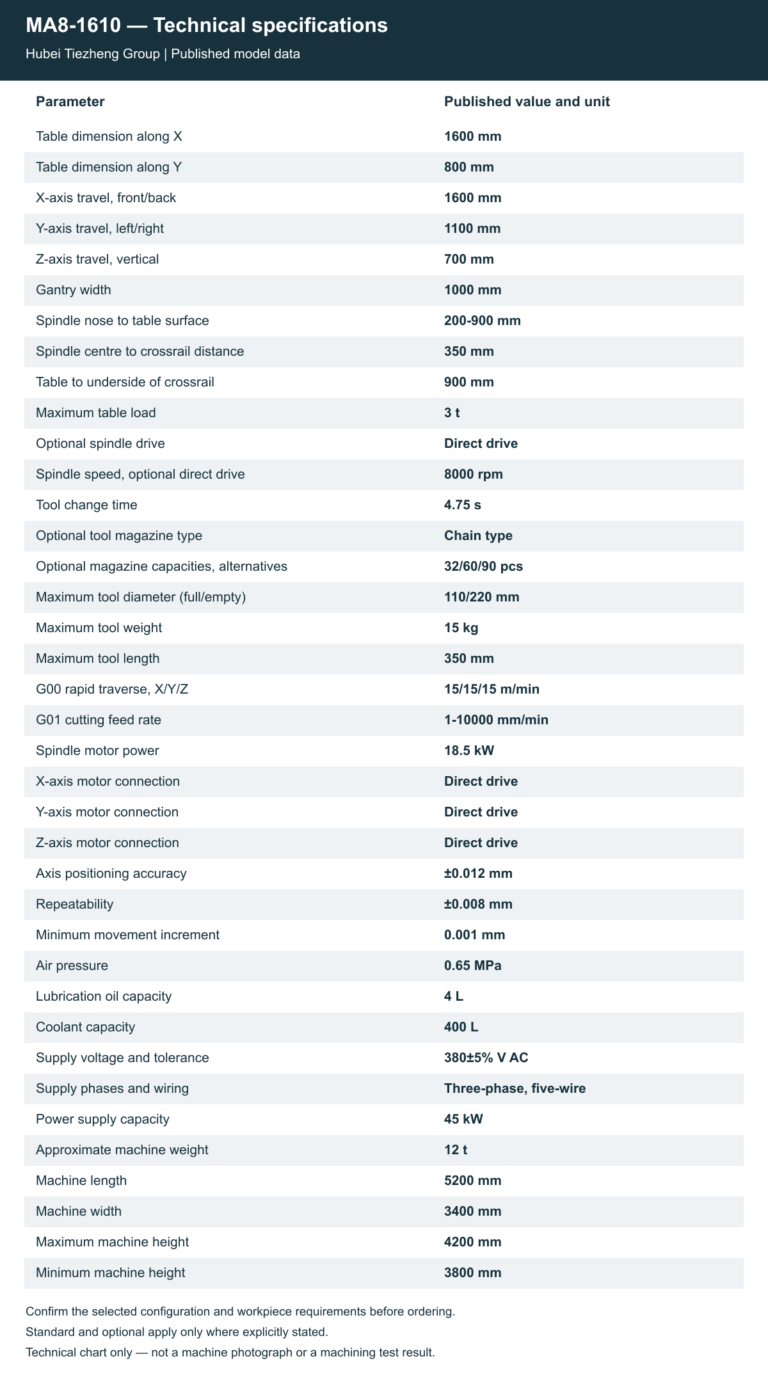
The MA8-1610 is listed under gantry machining centers in the Tiezheng catalogue. Table dimension along X: 1600 mm; Table dimension along Y: 800 mm. Published dimensions and spindle data do not approve a workpiece setup. Compare
The MB14-2016 is listed under gantry machining centers in the Tiezheng catalogue. Table dimension along X: 2000 mm; Table dimension along Y: 1400 mm. Published dimensions and spindle data do not approve a workpiece setup. Compare
The MB14-2516 is listed under gantry machining centers in the Tiezheng catalogue. Table dimension along X: 2500 mm; Table dimension along Y: 1400 mm. Published dimensions and spindle data do not approve a workpiece setup. Compare
The MB14-3016 is listed under gantry machining centers in the Tiezheng catalogue. Table dimension along X: 3000 mm; Table dimension along Y: 1400 mm. Published dimensions and spindle data do not approve a workpiece setup. Compare
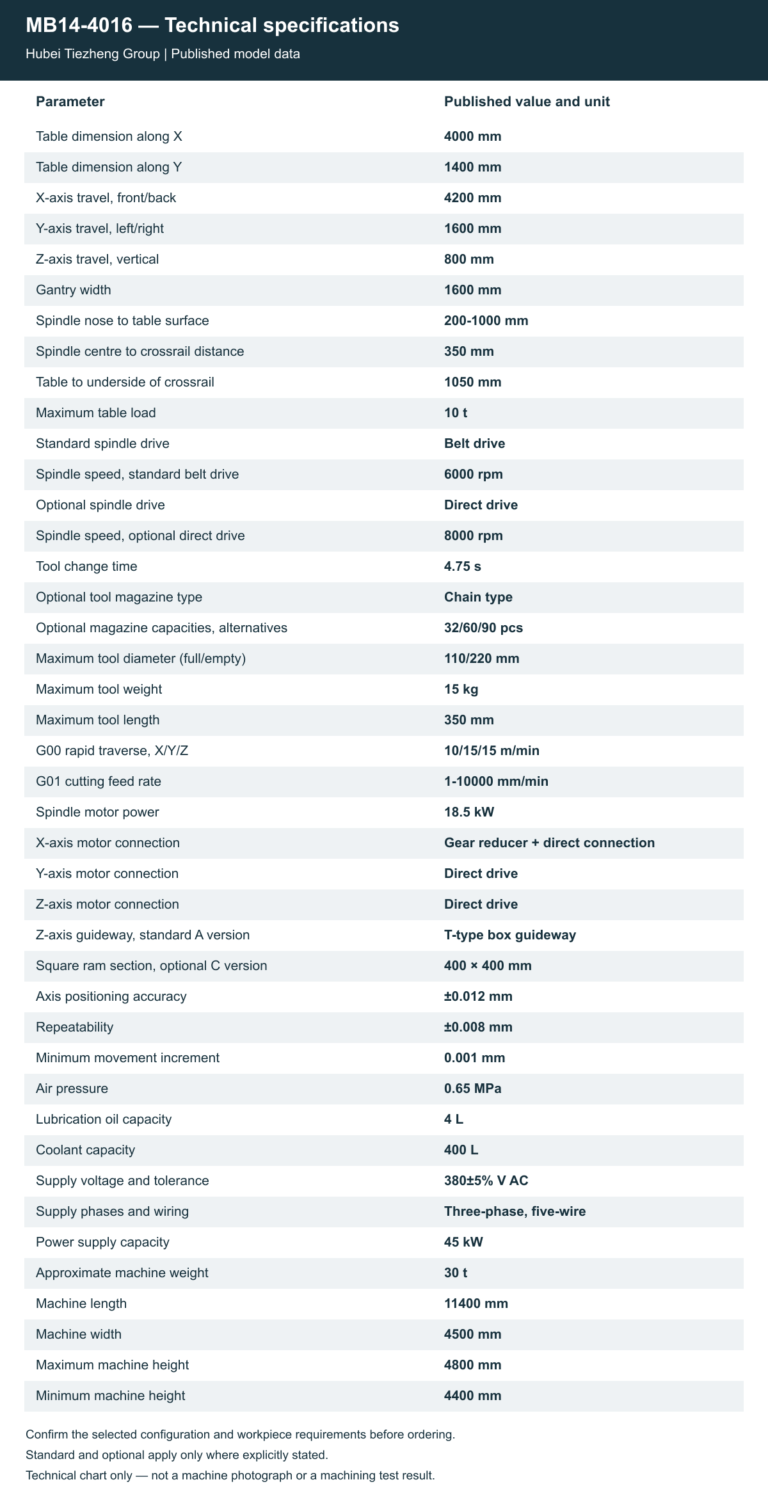
The MB14-4016 is listed under gantry machining centers in the Tiezheng catalogue. Table dimension along X: 4000 mm; Table dimension along Y: 1400 mm. Published dimensions and spindle data do not approve a workpiece setup. Compare
MB16-2019 is a gantry machining center with a 2000 × 1600 mm table, 2000 × 2000 × 1000 mm X/Y/Z-axis travels and a stated maximum table load of 9 t. Its standard belt-driven spindle is specified
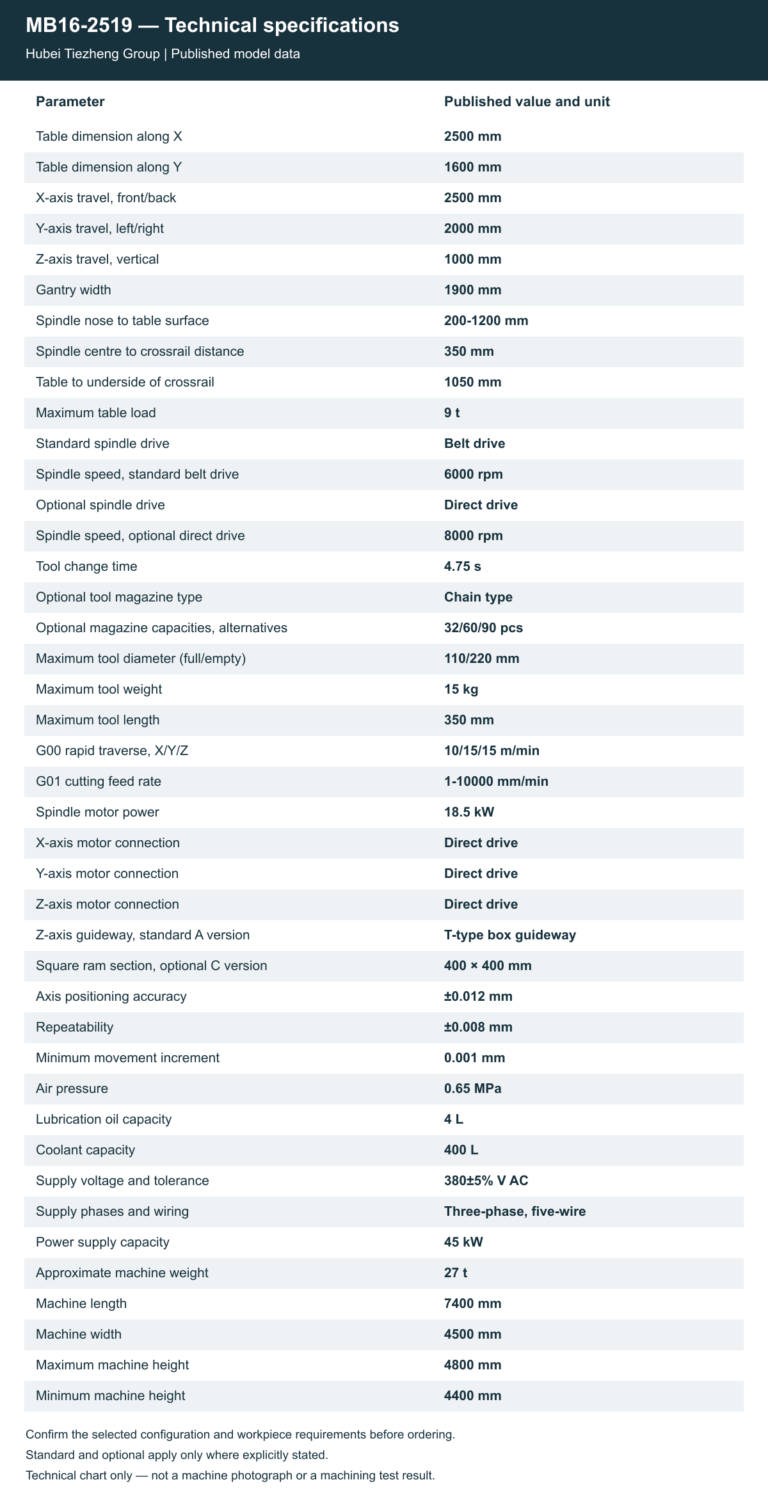
The MB16-2519 is listed under gantry machining centers in the Tiezheng catalogue. Table dimension along X: 2500 mm; Table dimension along Y: 1600 mm. Published dimensions and spindle data do not approve a workpiece setup. Compare
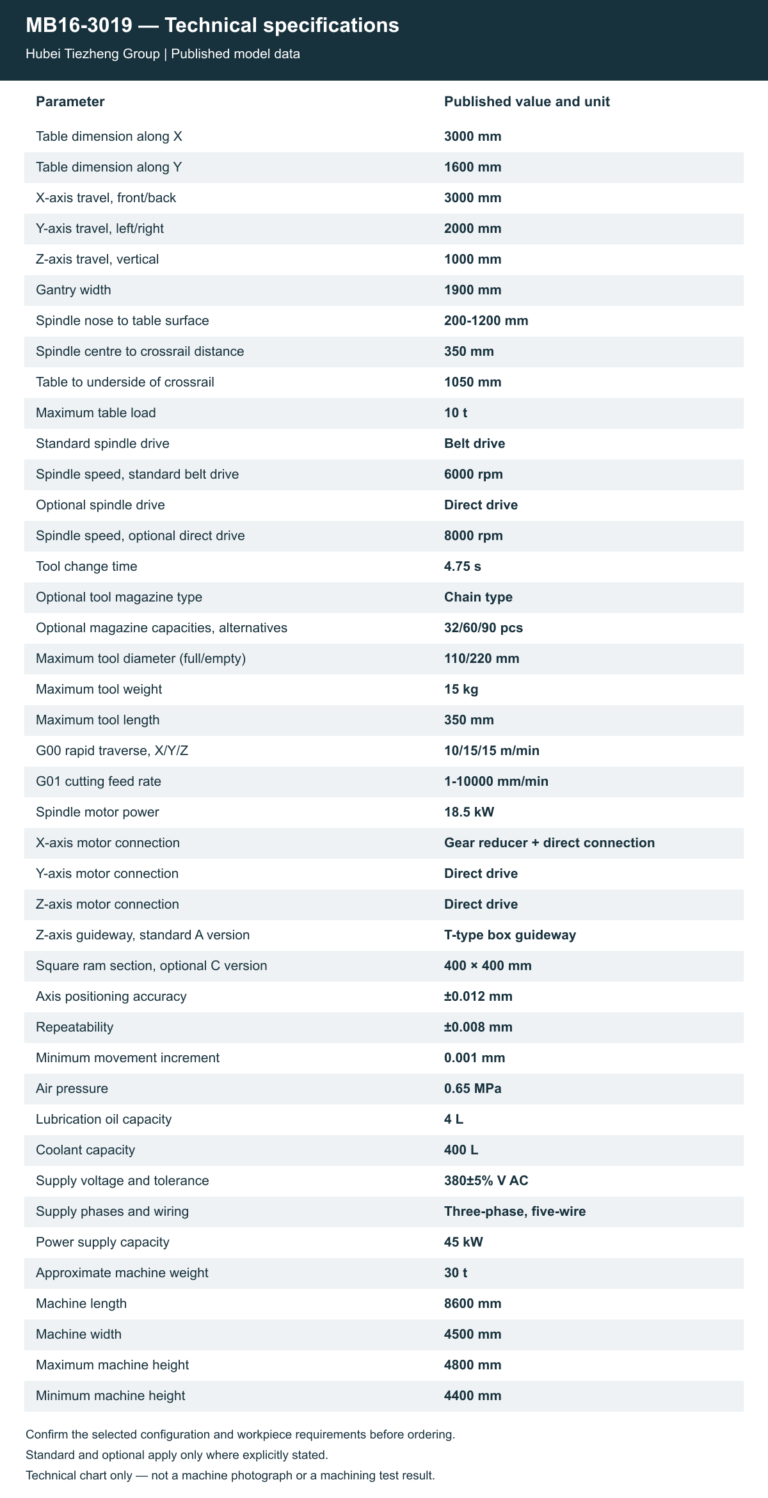
The MB16-3019 is listed under gantry machining centers in the Tiezheng catalogue. Table dimension along X: 3000 mm; Table dimension along Y: 1600 mm. Published dimensions and spindle data do not approve a workpiece setup. Compare
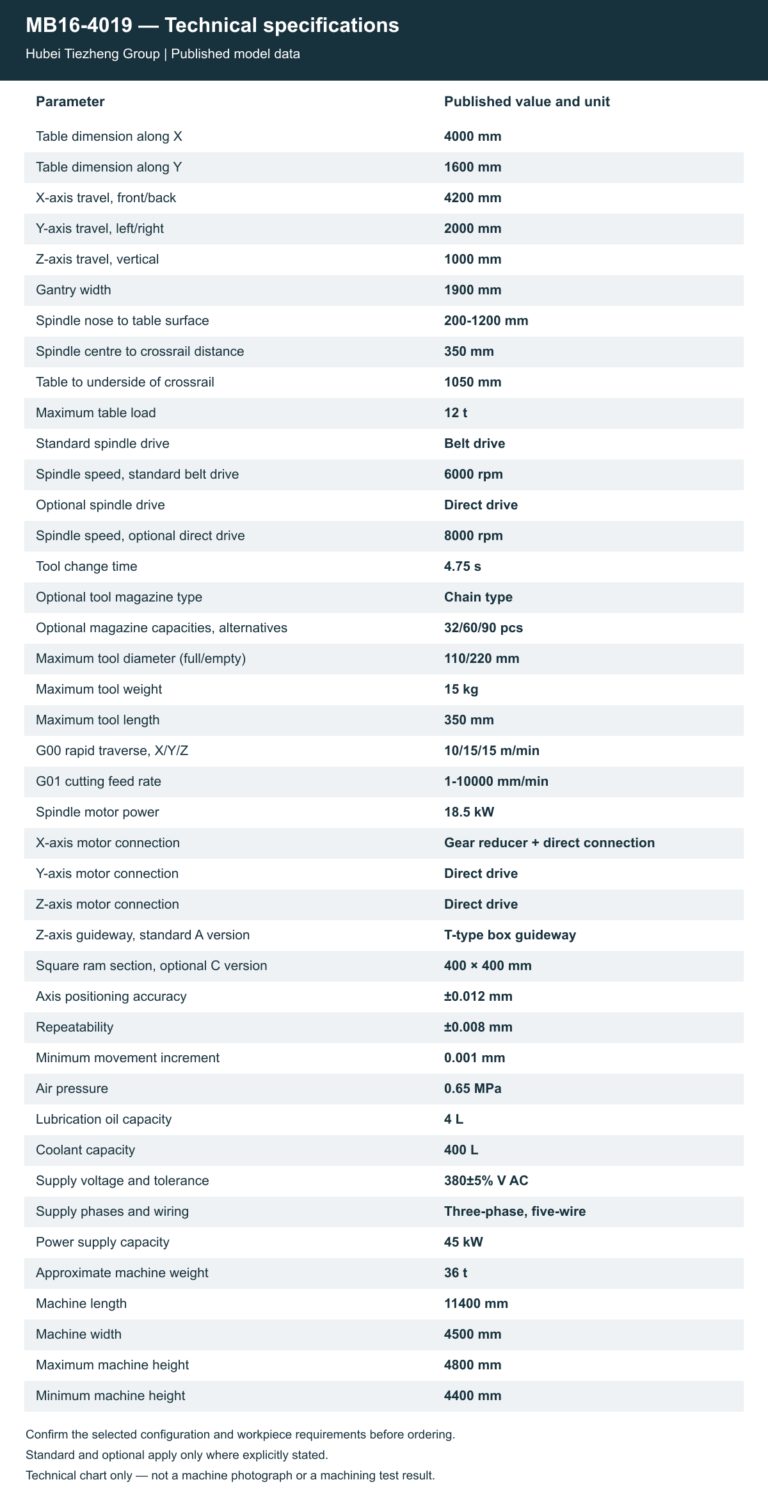
The MB16-4019 is listed under gantry machining centers in the Tiezheng catalogue. Table dimension along X: 4000 mm; Table dimension along Y: 1600 mm. Published dimensions and spindle data do not approve a workpiece setup. Compare
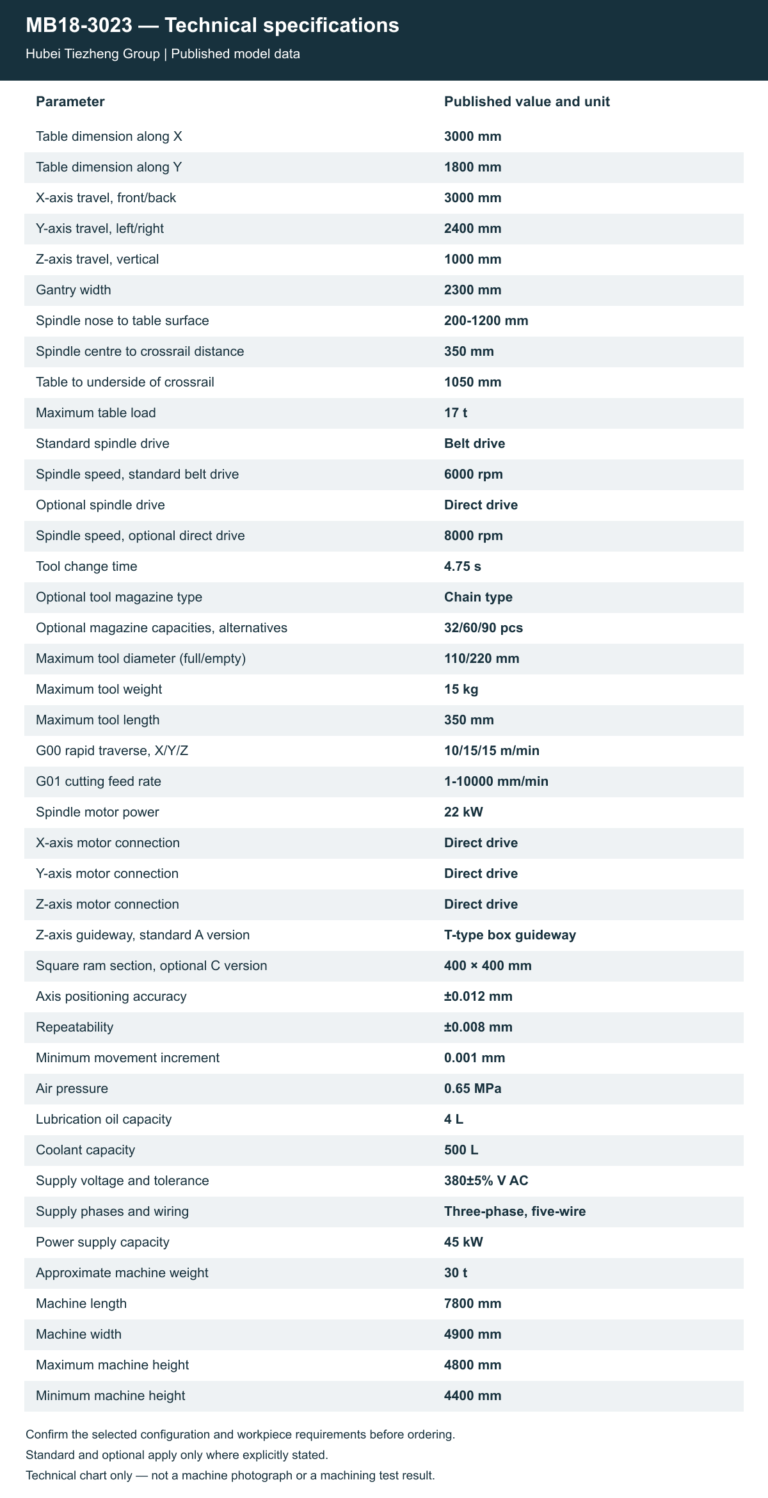
The MB18-3023 is listed under gantry machining centers in the Tiezheng catalogue. Table dimension along X: 3000 mm; Table dimension along Y: 1800 mm. Published dimensions and spindle data do not approve a workpiece setup. Compare
The MB18-4023 is listed under gantry machining centers in the Tiezheng catalogue. Table dimension along X: 4000 mm; Table dimension along Y: 1800 mm. Published dimensions and spindle data do not approve a workpiece setup. Compare
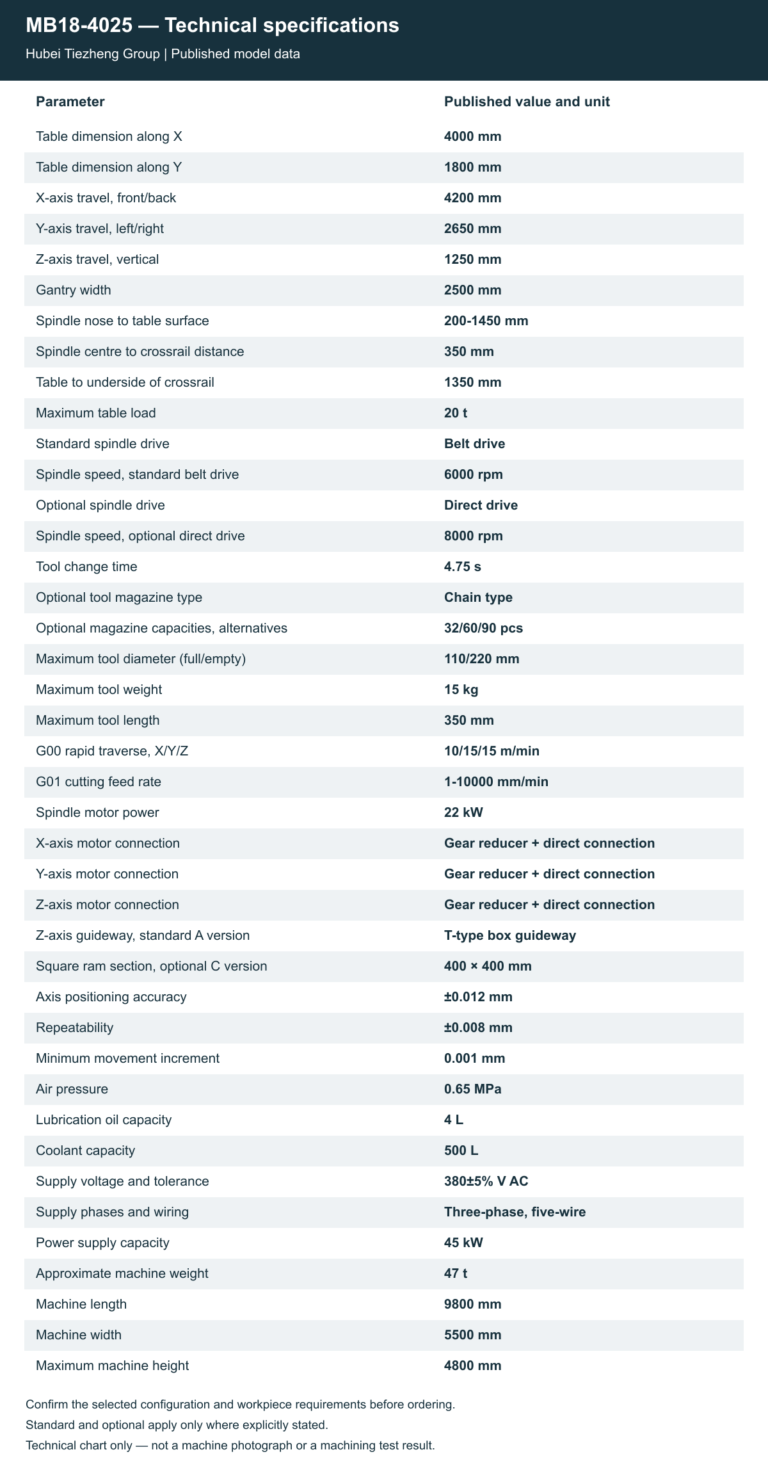
The MB18-4025 is listed under gantry machining centers in the Tiezheng catalogue. Table dimension along X: 4000 mm; Table dimension along Y: 1800 mm. Published dimensions and spindle data do not approve a workpiece setup. Compare
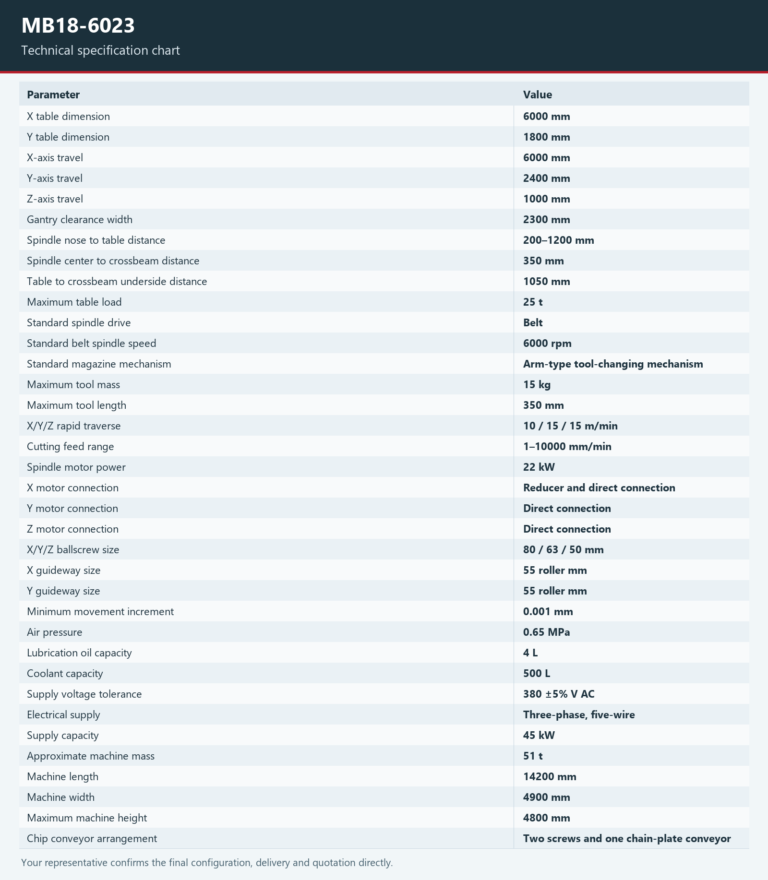
MB18-6023 is a gantry machining center with a 6000 × 1800 mm table, 6000 × 2400 × 1000 mm X/Y/Z-axis travels and a stated maximum table load of 25 t. Its standard belt-driven spindle is specified
MB22-3030 is a gantry machining center with a 3000 × 2200 mm table, 3000 × 3100 × 1000 mm X/Y/Z-axis travels and a stated maximum table load of 17 t. Its standard belt-driven spindle is specified
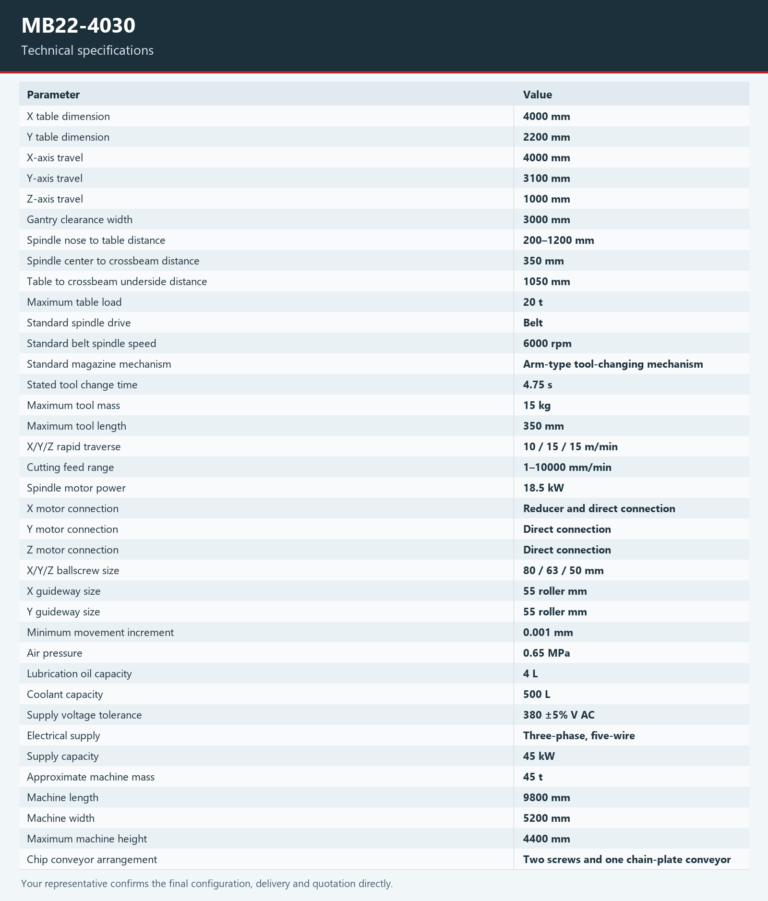
MB22-4030 is a gantry machining center with a 4000 × 2200 mm table, 4000 × 3100 × 1000 mm X/Y/Z-axis travels and a stated maximum table load of 20 t. Its standard belt-driven spindle is specified
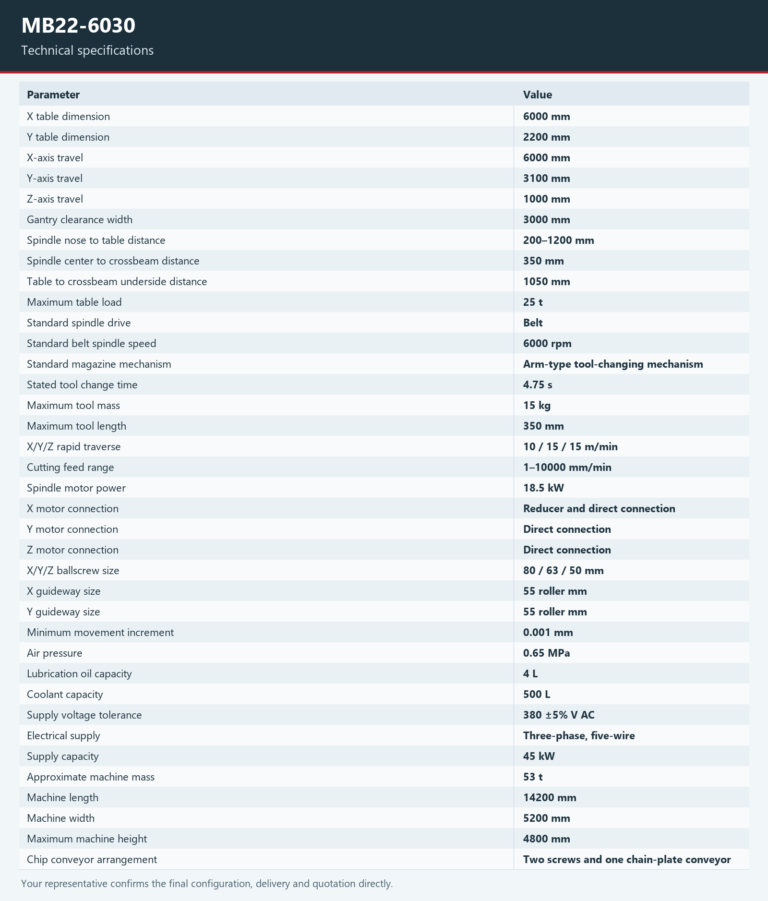
MB22-6030 is a gantry machining center with a 6000 × 2200 mm table, 6000 × 3100 × 1000 mm X/Y/Z-axis travels and a stated maximum table load of 25 t. Its standard belt-driven spindle is specified
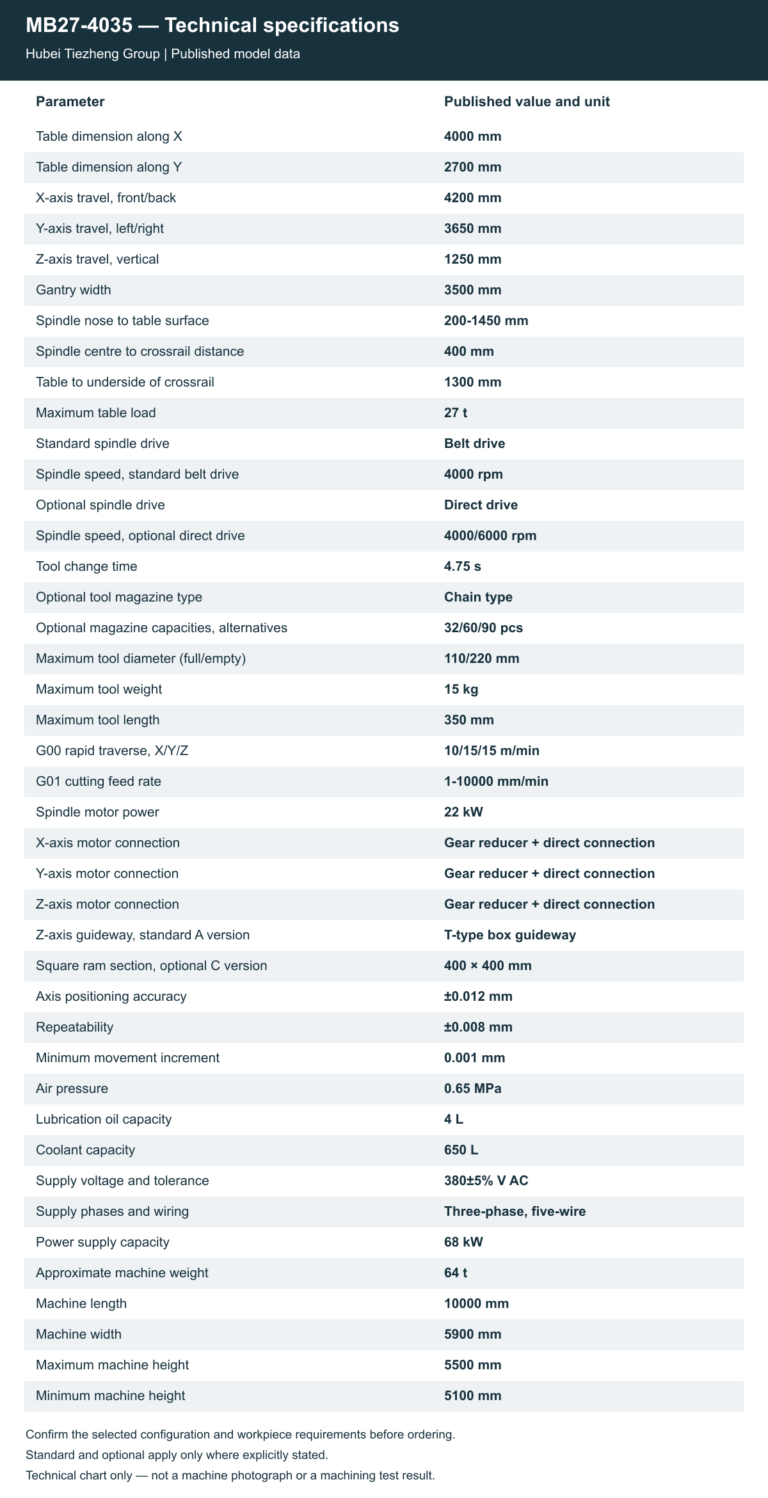
The MB27-4035 is listed under gantry machining centers in the Tiezheng catalogue. Table dimension along X: 4000 mm; Table dimension along Y: 2700 mm. Published dimensions and spindle data do not approve a workpiece setup. Compare
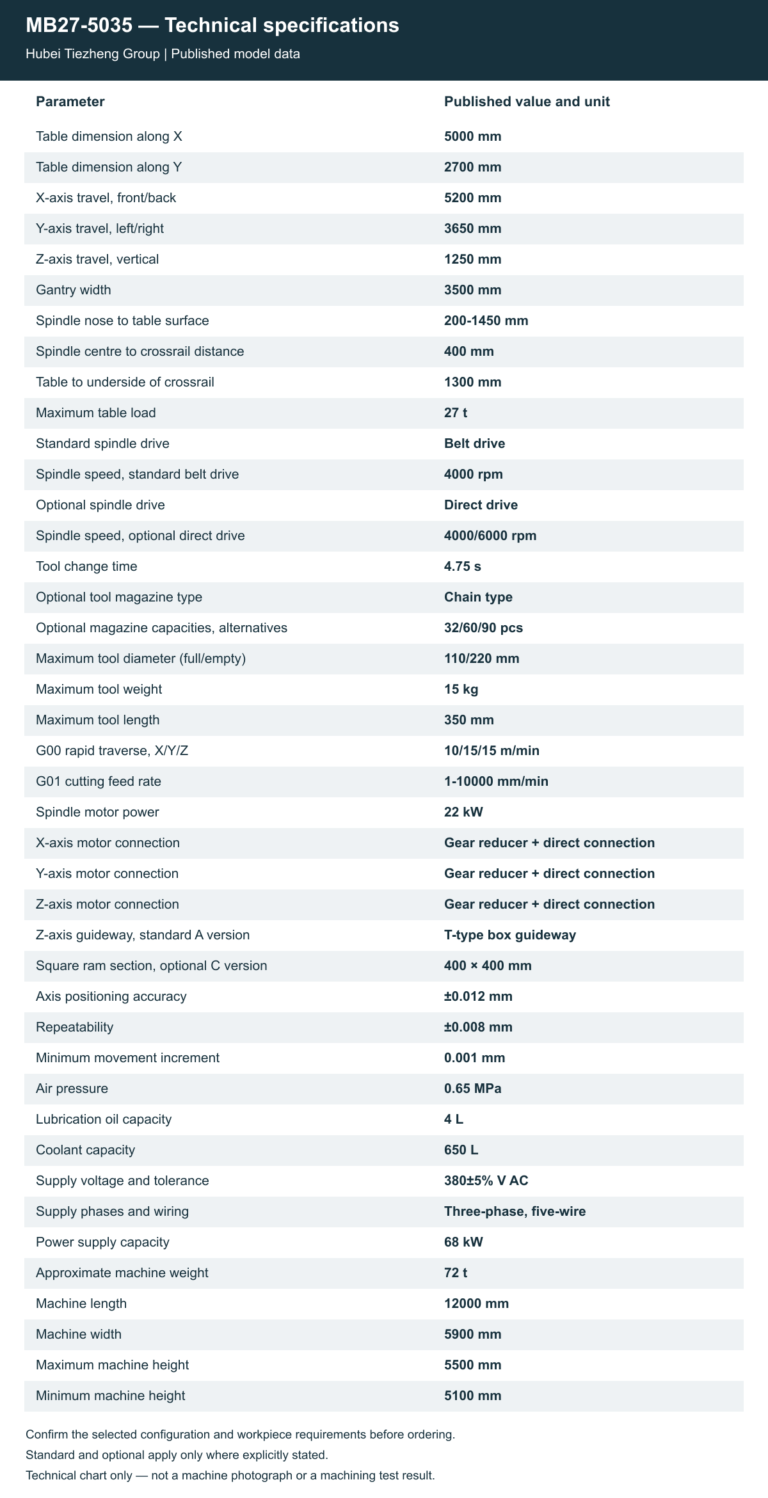
The MB27-5035 is listed under gantry machining centers in the Tiezheng catalogue. Table dimension along X: 5000 mm; Table dimension along Y: 2700 mm. Published dimensions and spindle data do not approve a workpiece setup. Compare
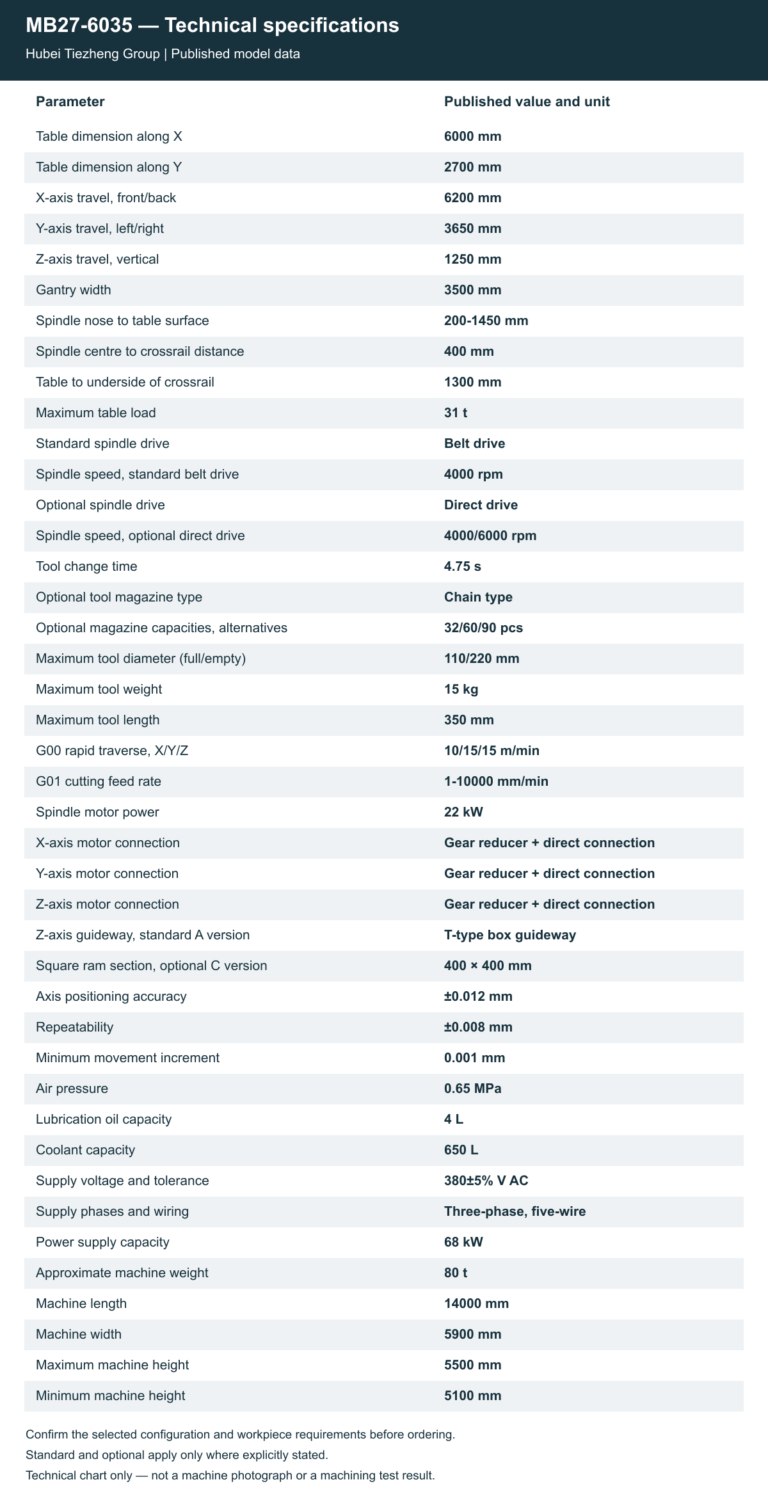
The MB27-6035 is listed under gantry machining centers in the Tiezheng catalogue. Table dimension along X: 6000 mm; Table dimension along Y: 2700 mm. Published dimensions and spindle data do not approve a workpiece setup. Compare
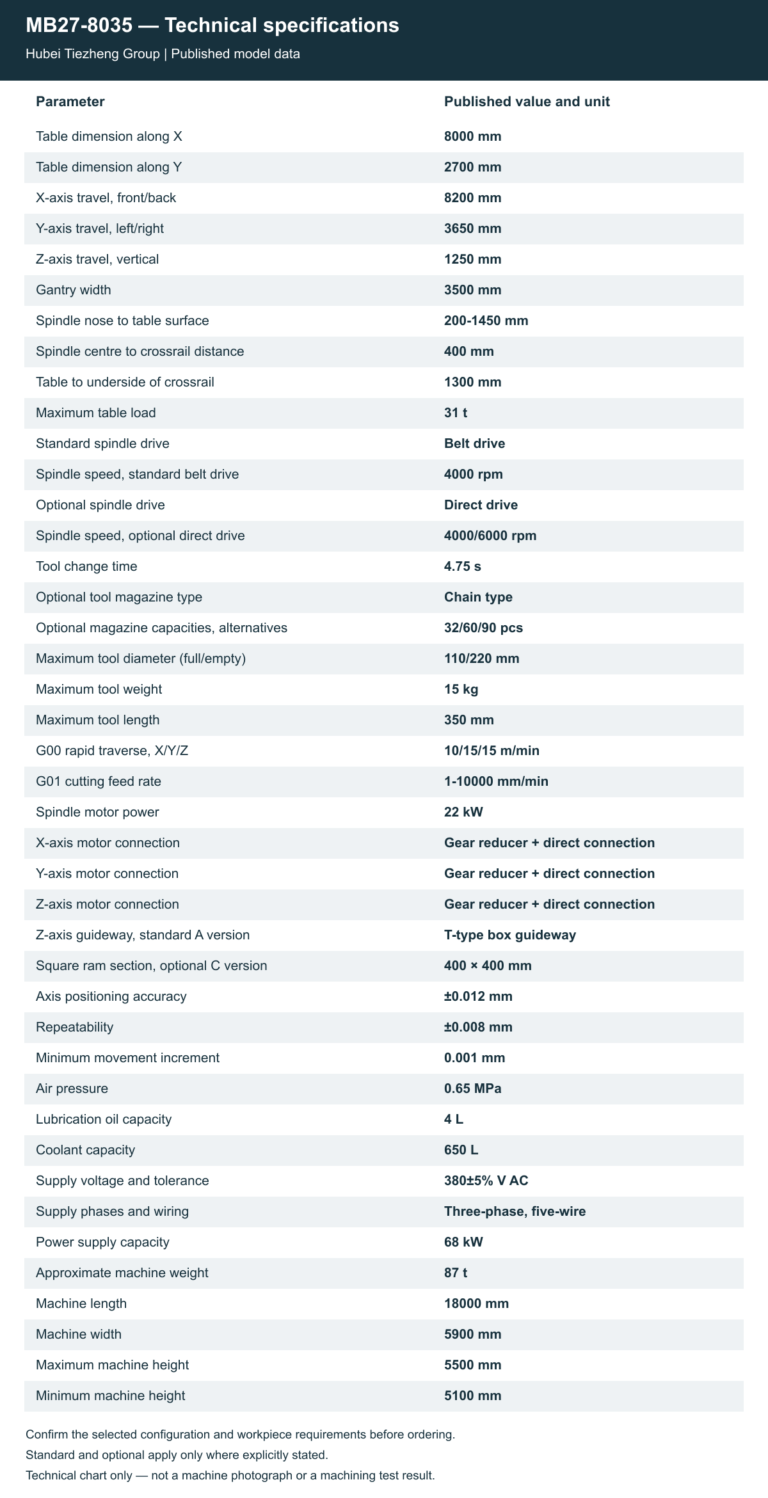
The MB27-8035 is listed under gantry machining centers in the Tiezheng catalogue. Table dimension along X: 8000 mm; Table dimension along Y: 2700 mm. Published dimensions and spindle data do not approve a workpiece setup. Compare
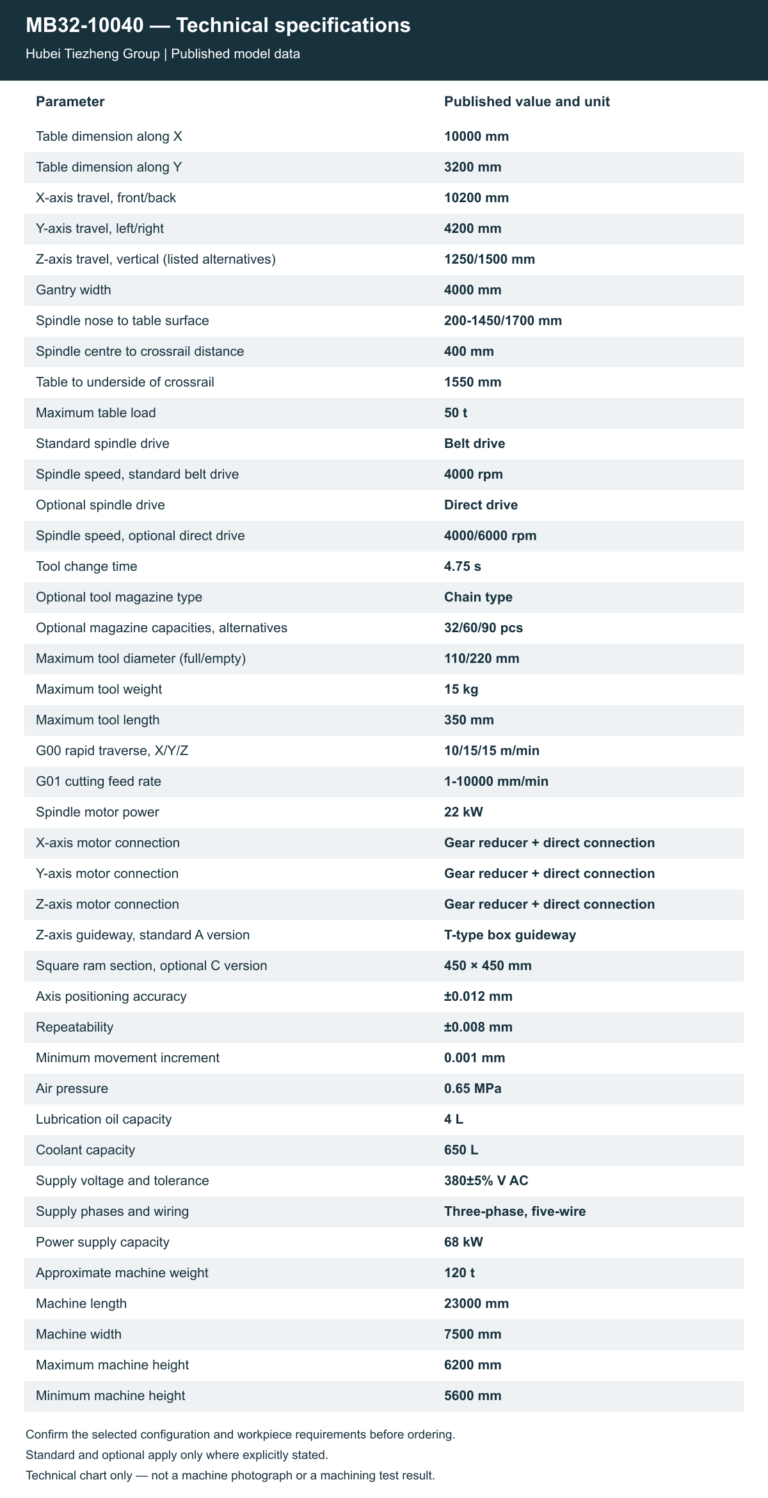
The MB32-10040 is listed under gantry machining centers in the Tiezheng catalogue. Table dimension along X: 10000 mm; Table dimension along Y: 3200 mm. Published dimensions and spindle data do not approve a workpiece setup. Compare
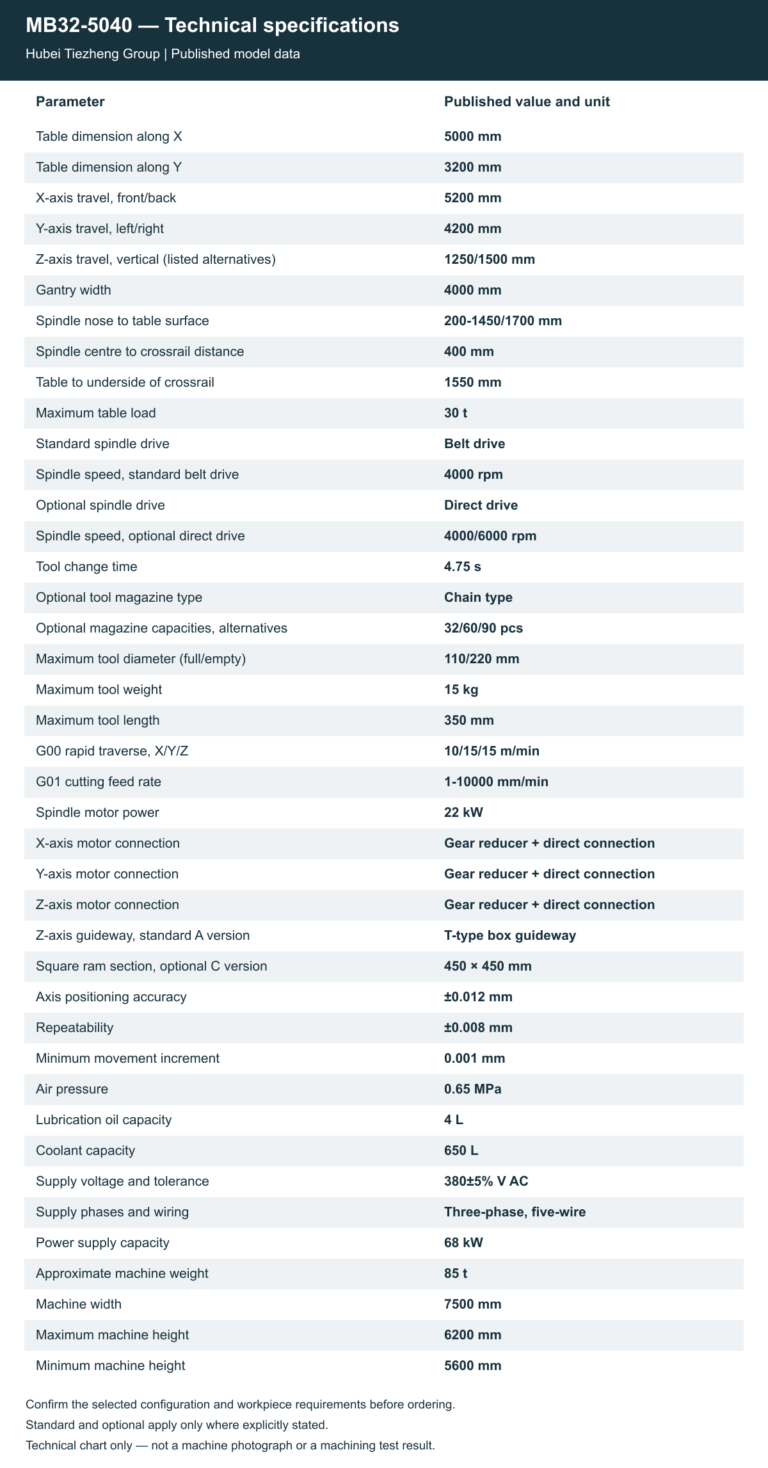
The MB32-5040 is listed under gantry machining centers in the Tiezheng catalogue. Table dimension along X: 5000 mm; Table dimension along Y: 3200 mm. Published dimensions and spindle data do not approve a workpiece setup. Compare
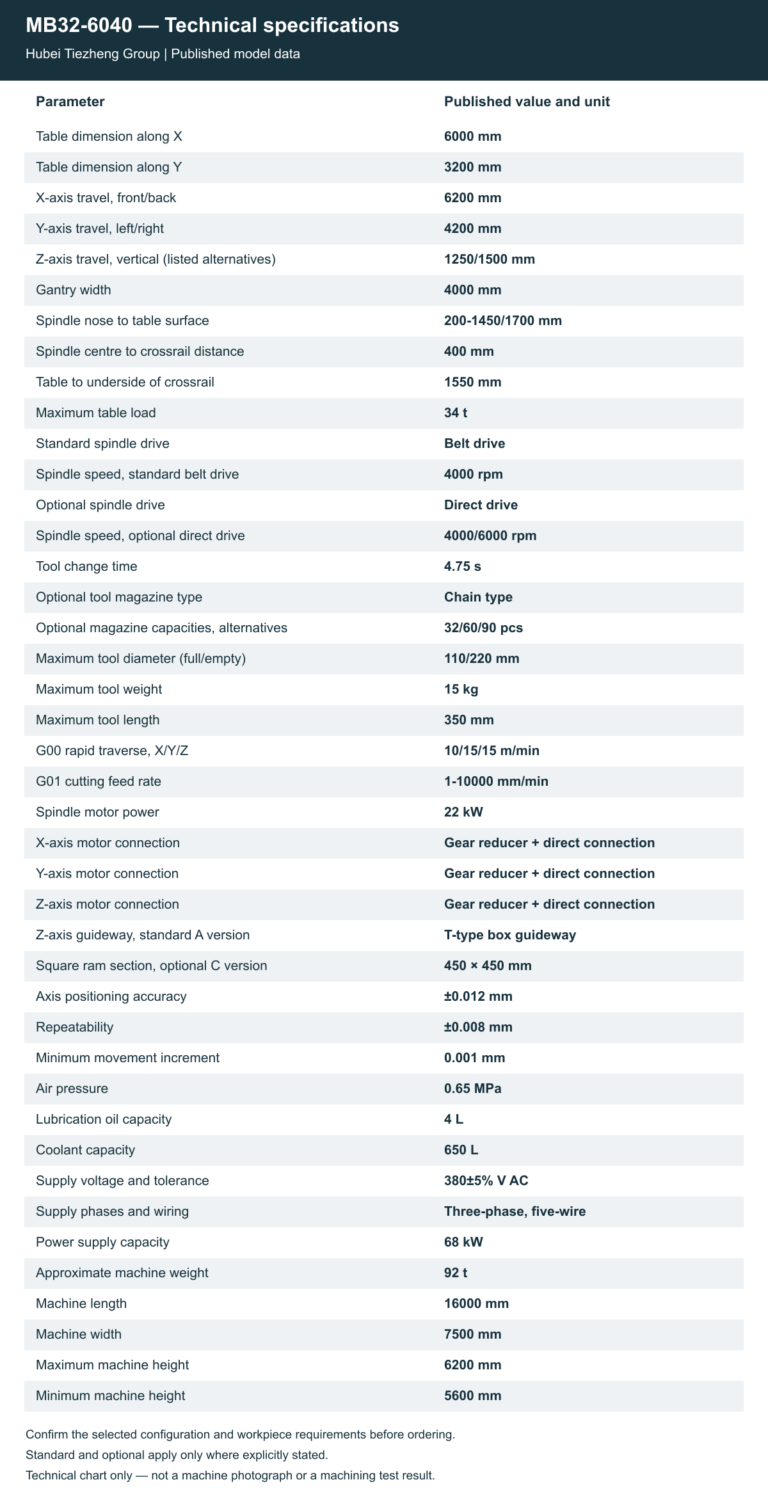
The MB32-6040 is listed under gantry machining centers in the Tiezheng catalogue. Table dimension along X: 6000 mm; Table dimension along Y: 3200 mm. Published dimensions and spindle data do not approve a workpiece setup. Compare
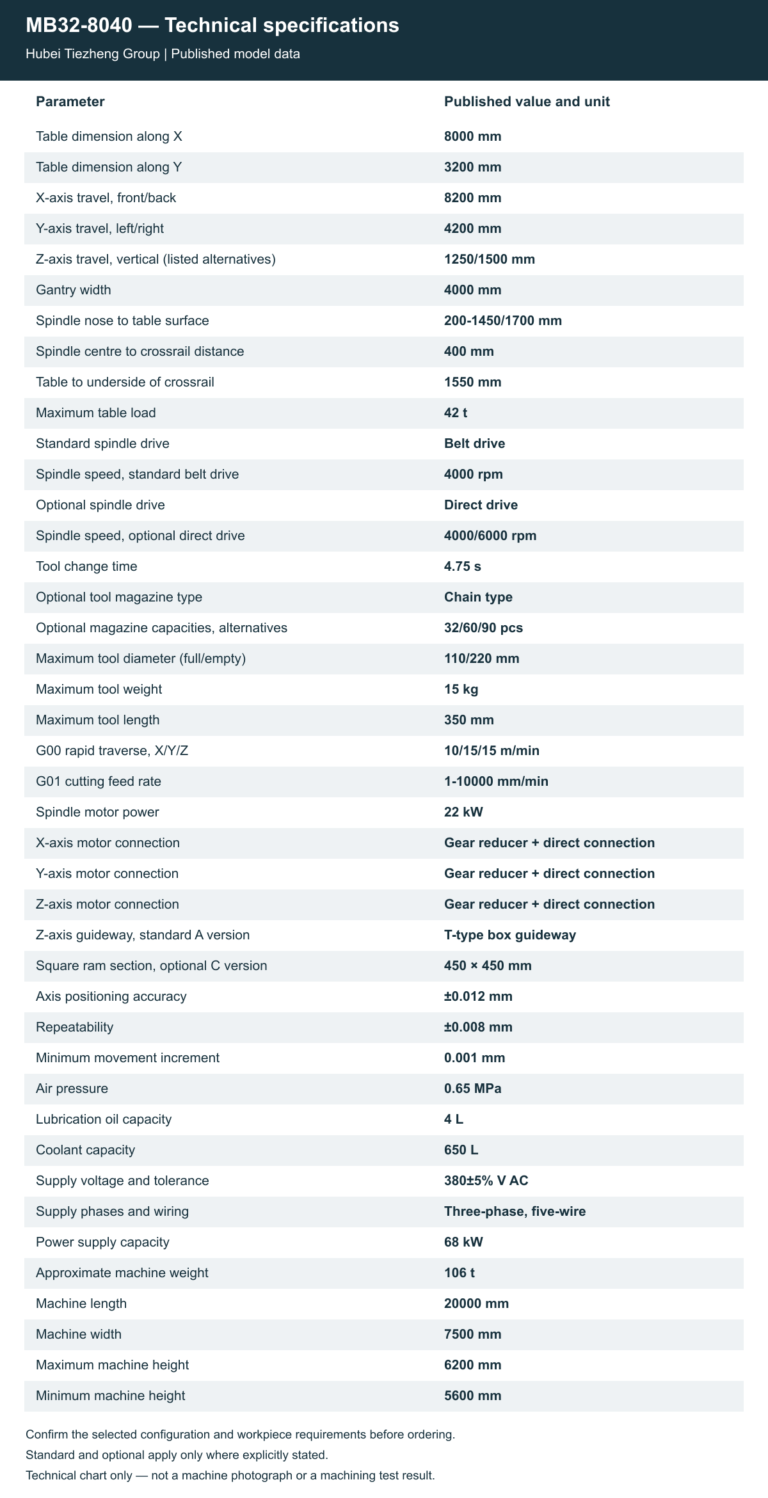
The MB32-8040 is listed under gantry machining centers in the Tiezheng catalogue. Table dimension along X: 8000 mm; Table dimension along Y: 3200 mm. Published dimensions and spindle data do not approve a workpiece setup. Compare
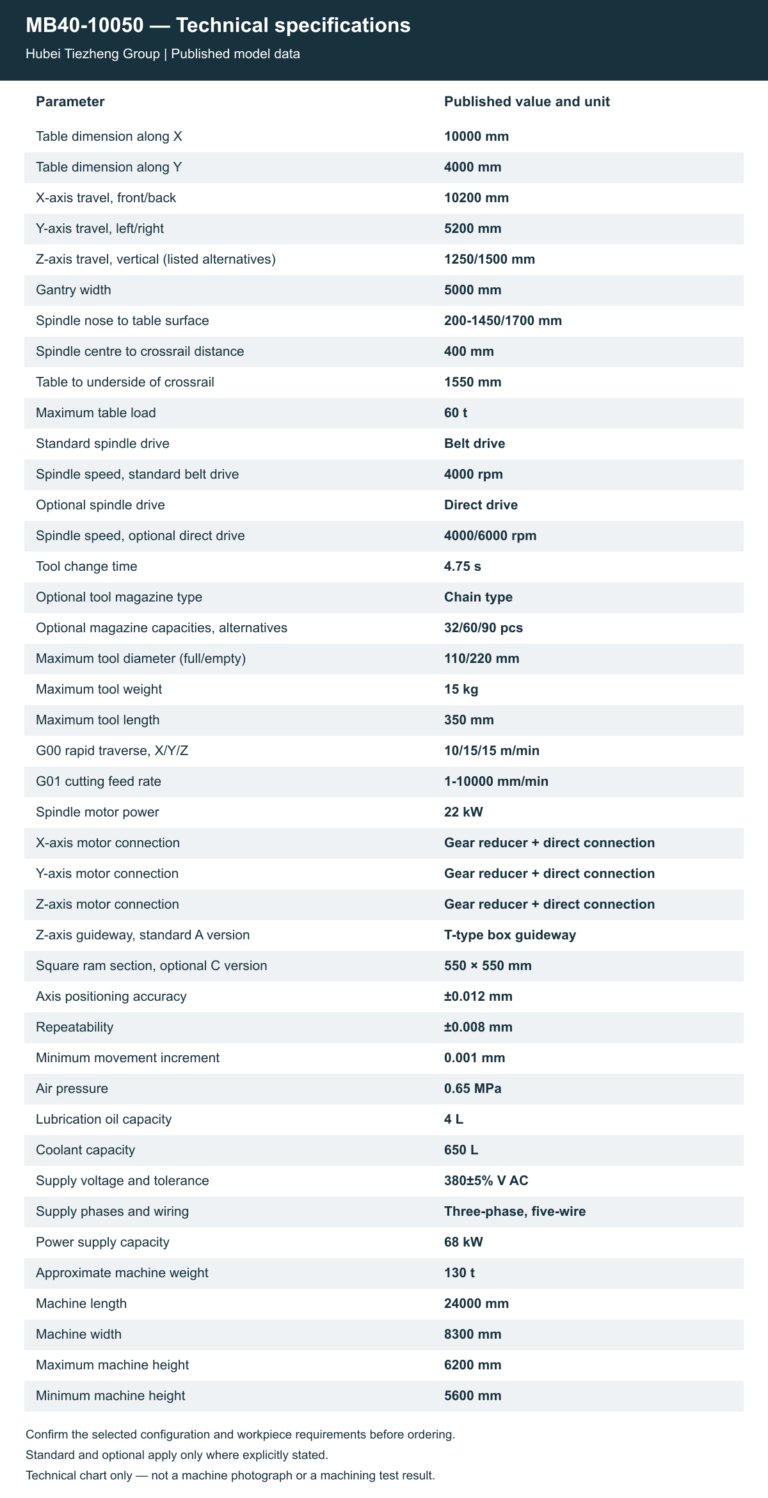
The MB40-10050 is listed under gantry machining centers in the Tiezheng catalogue. Table dimension along X: 10000 mm; Table dimension along Y: 4000 mm. Published dimensions and spindle data do not approve a workpiece setup. Compare
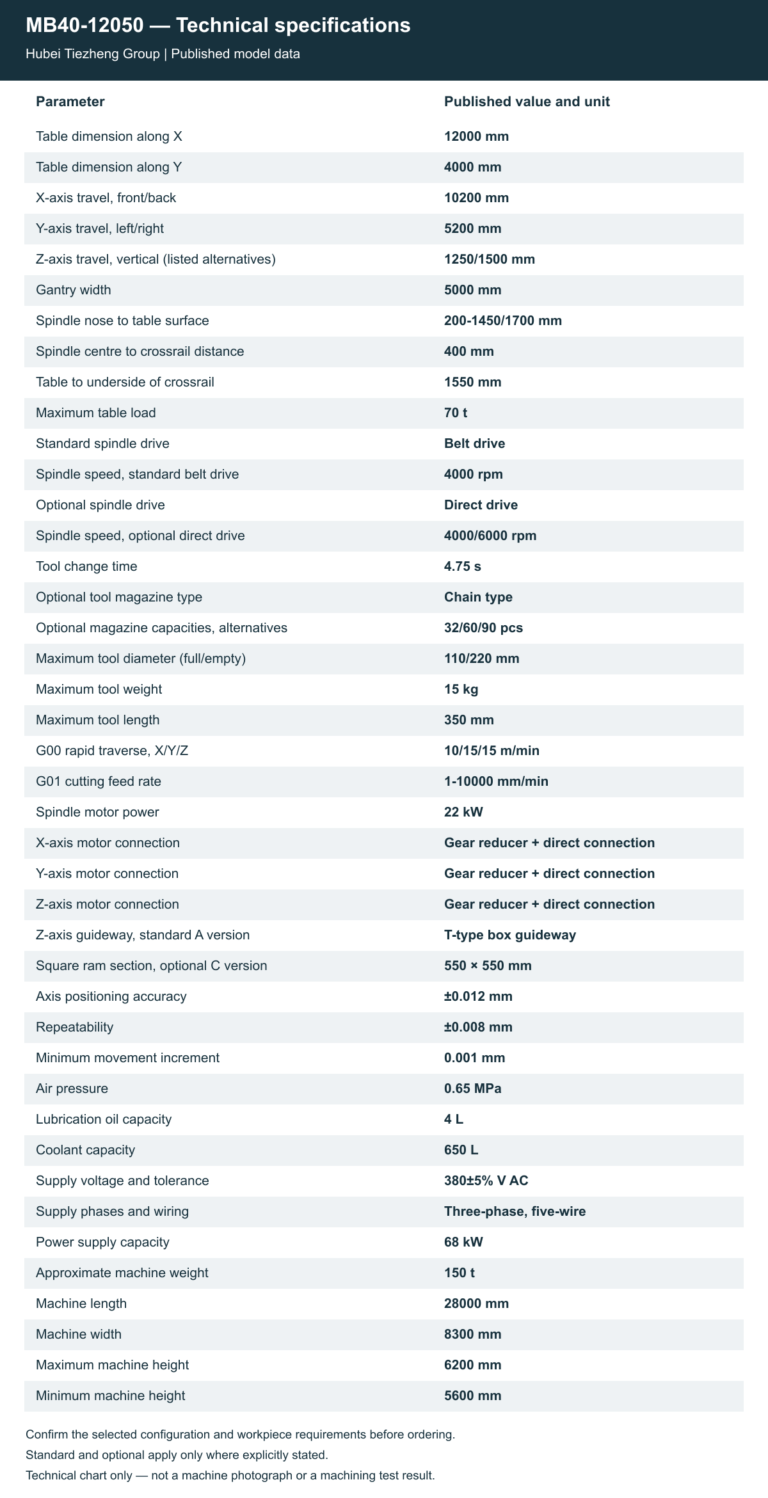
The MB40-12050 is listed under gantry machining centers in the Tiezheng catalogue. Table dimension along X: 12000 mm; Table dimension along Y: 4000 mm. Published dimensions and spindle data do not approve a workpiece setup. Compare
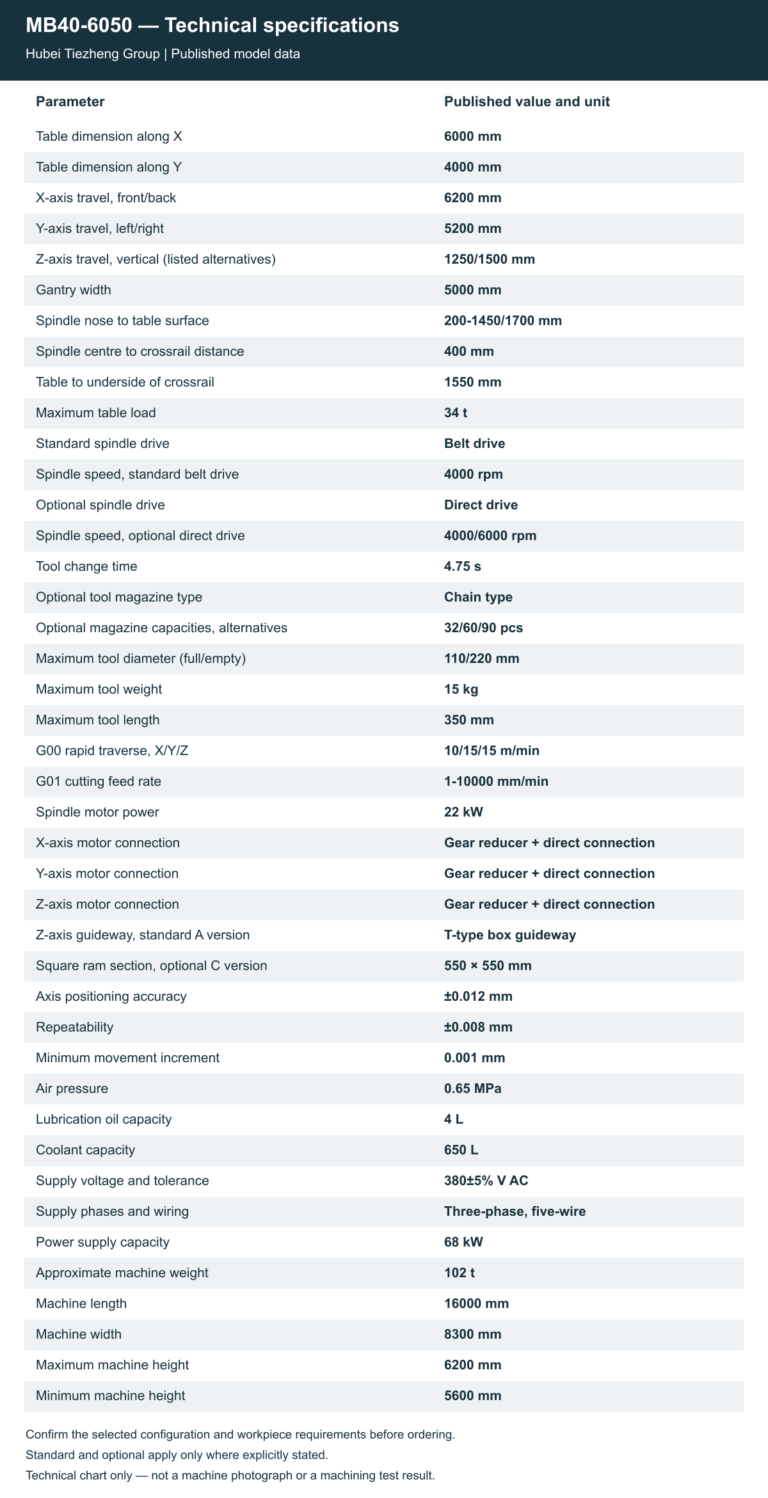
The MB40-6050 is listed under gantry machining centers in the Tiezheng catalogue. Table dimension along X: 6000 mm; Table dimension along Y: 4000 mm. Published dimensions and spindle data do not approve a workpiece setup. Compare
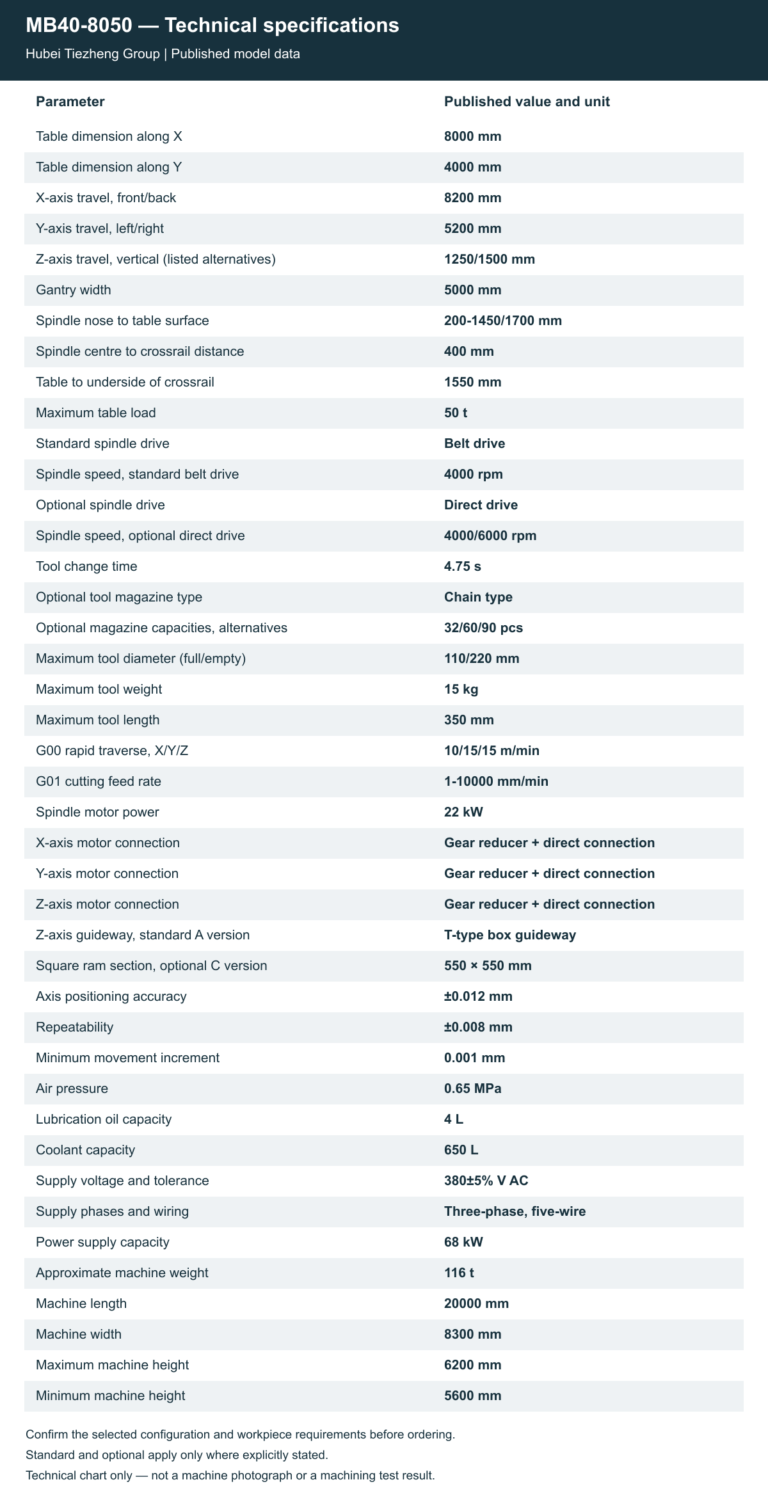
The MB40-8050 is listed under gantry machining centers in the Tiezheng catalogue. Table dimension along X: 8000 mm; Table dimension along Y: 4000 mm. Published dimensions and spindle data do not approve a workpiece setup. Compare
The ME5200 is listed under gantry machining centers in the Tiezheng catalogue. Table size, X/Y: 5000 × 5000 mm; X/Y-axis travel: 5200 × 5200 mm. Published dimensions and spindle data do not approve a workpiece setup.
The ME6200 is listed under gantry machining centers in the Tiezheng catalogue. Table size, X/Y: 6000 × 6000 mm; X/Y-axis travel: 6200 × 6200 mm. Published dimensions and spindle data do not approve a workpiece setup.
The MF10030 is listed under gantry machining centers in the Tiezheng catalogue. Table Width: 10000 mm; Table Length: 3000 mm. Published dimensions and spindle data do not approve a workpiece setup. Compare the complete specification table,
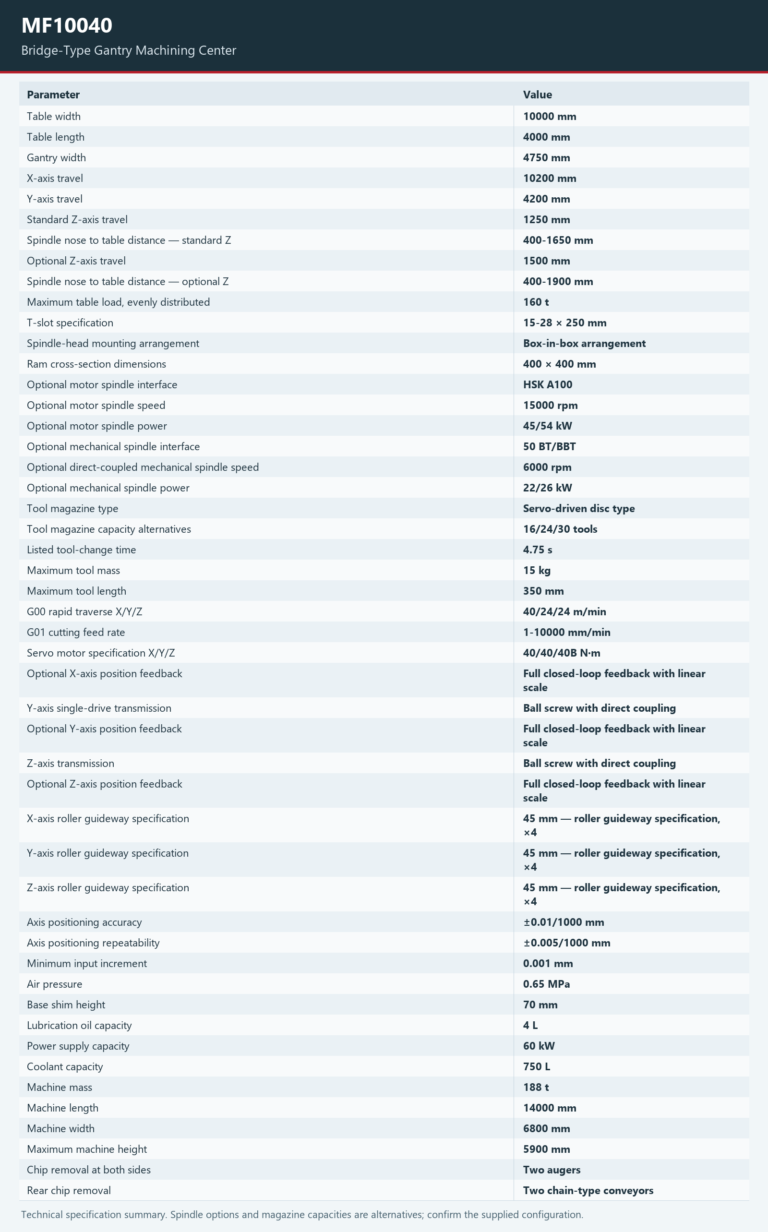
MF10040 is a bridge-type gantry machining center with a table width of 10000 mm, table length of 4000 mm and X/Y/standard-Z travels of 10200 / 4200 / 1250 mm. Its listed evenly distributed table-load limit is
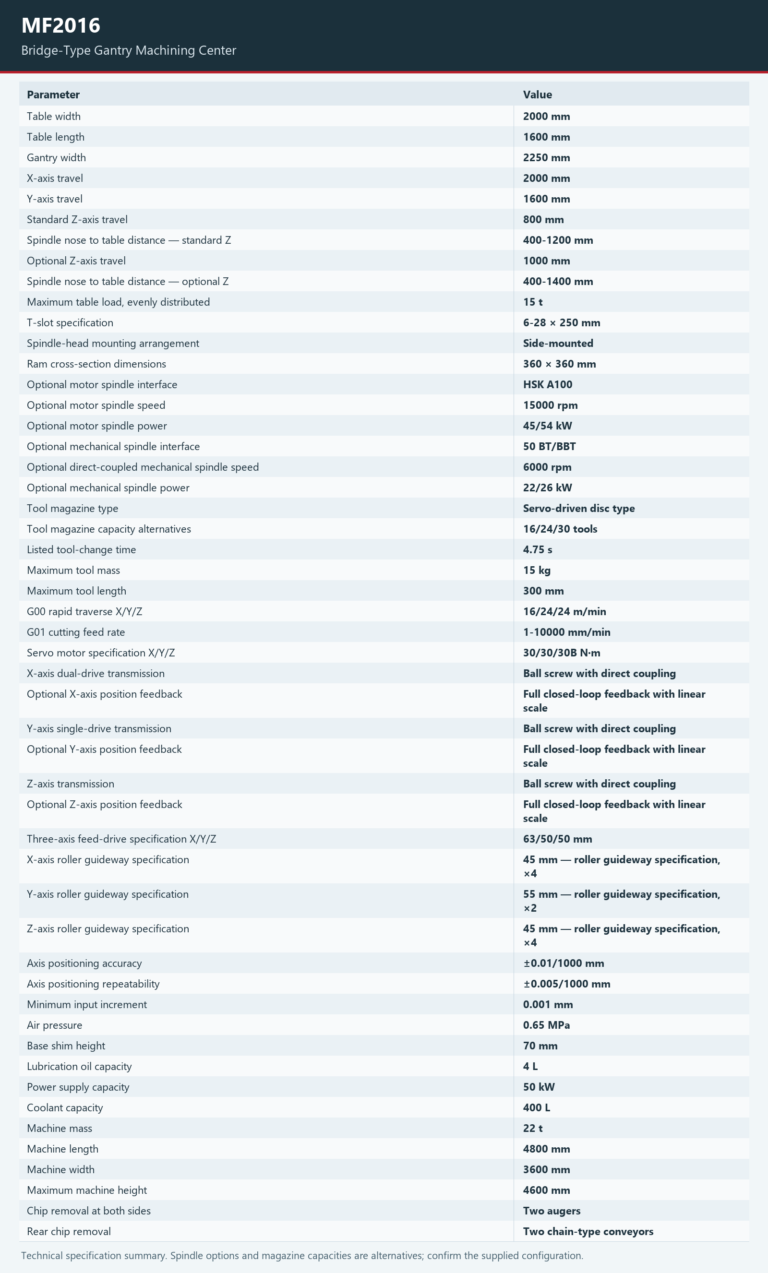
MF2016 is a bridge-type gantry machining center with a table width of 2000 mm, table length of 1600 mm and X/Y/standard-Z travels of 2000 / 1600 / 800 mm. Its listed evenly distributed table-load limit is
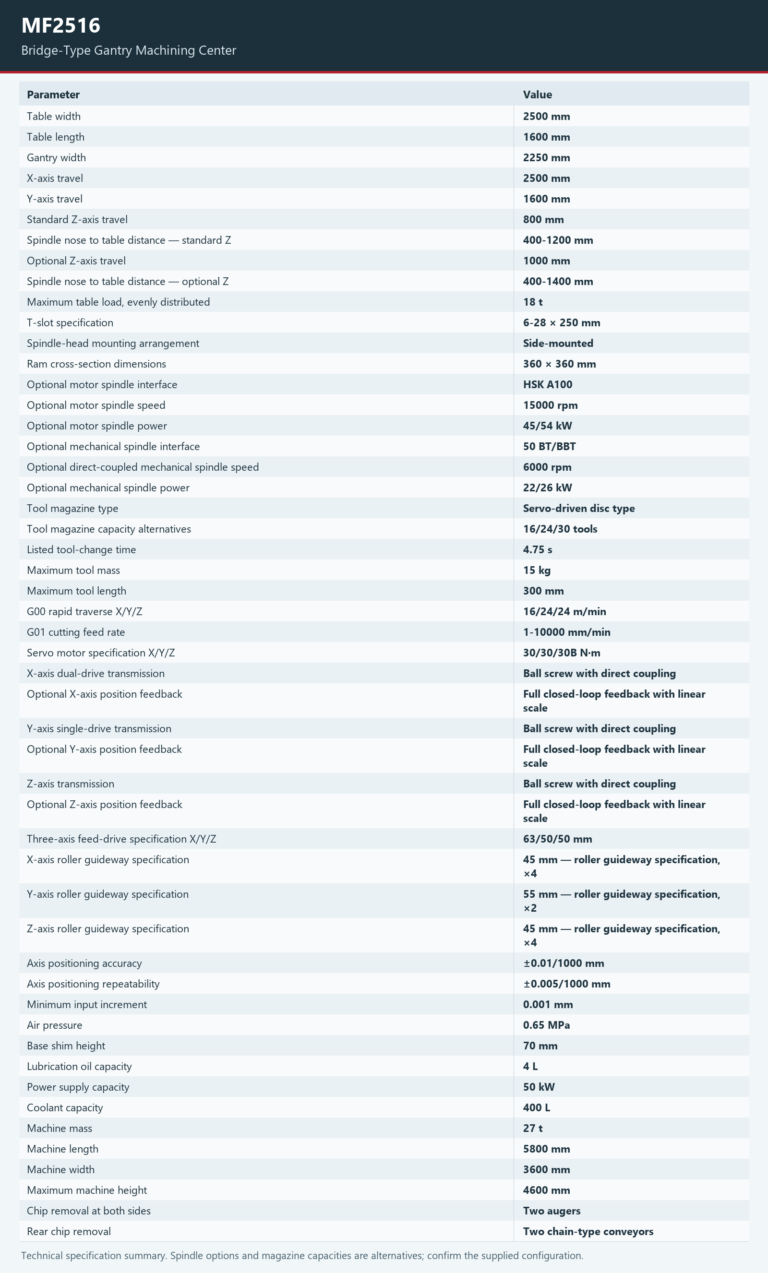
MF2516 is a bridge-type gantry machining center with a table width of 2500 mm, table length of 1600 mm and X/Y/standard-Z travels of 2500 / 1600 / 800 mm. Its listed evenly distributed table-load limit is
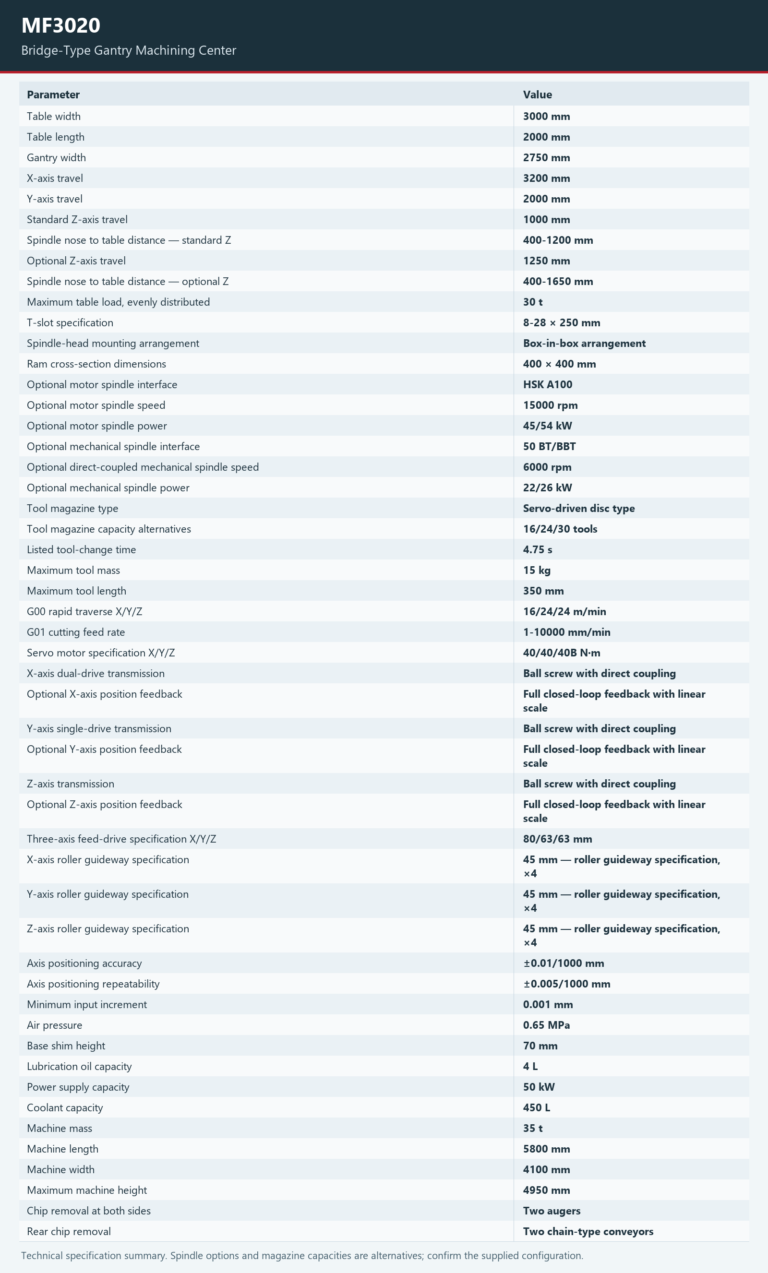
MF3020 is a bridge-type gantry machining center with a table width of 3000 mm, table length of 2000 mm and X/Y/standard-Z travels of 3200 / 2000 / 1000 mm. Its listed evenly distributed table-load limit is
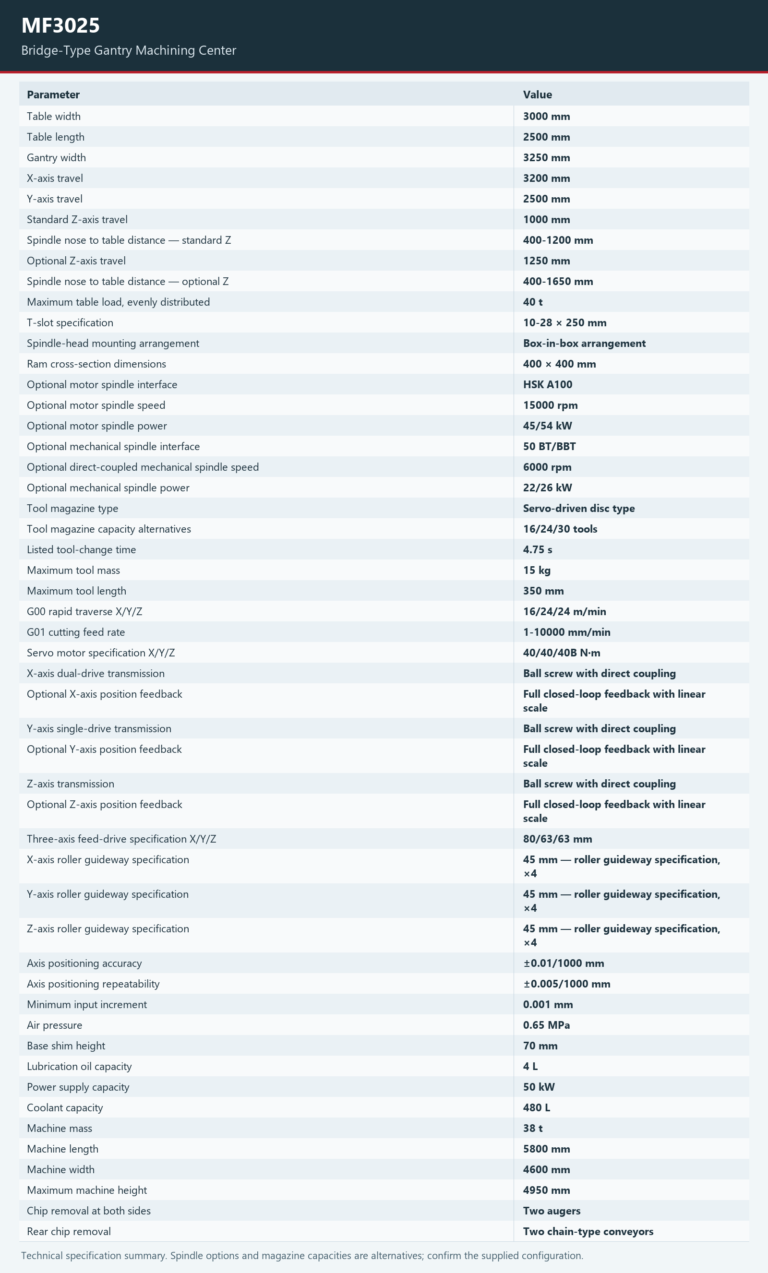
MF3025 is a bridge-type gantry machining center with a table width of 3000 mm, table length of 2500 mm and X/Y/standard-Z travels of 3200 / 2500 / 1000 mm. Its listed evenly distributed table-load limit is
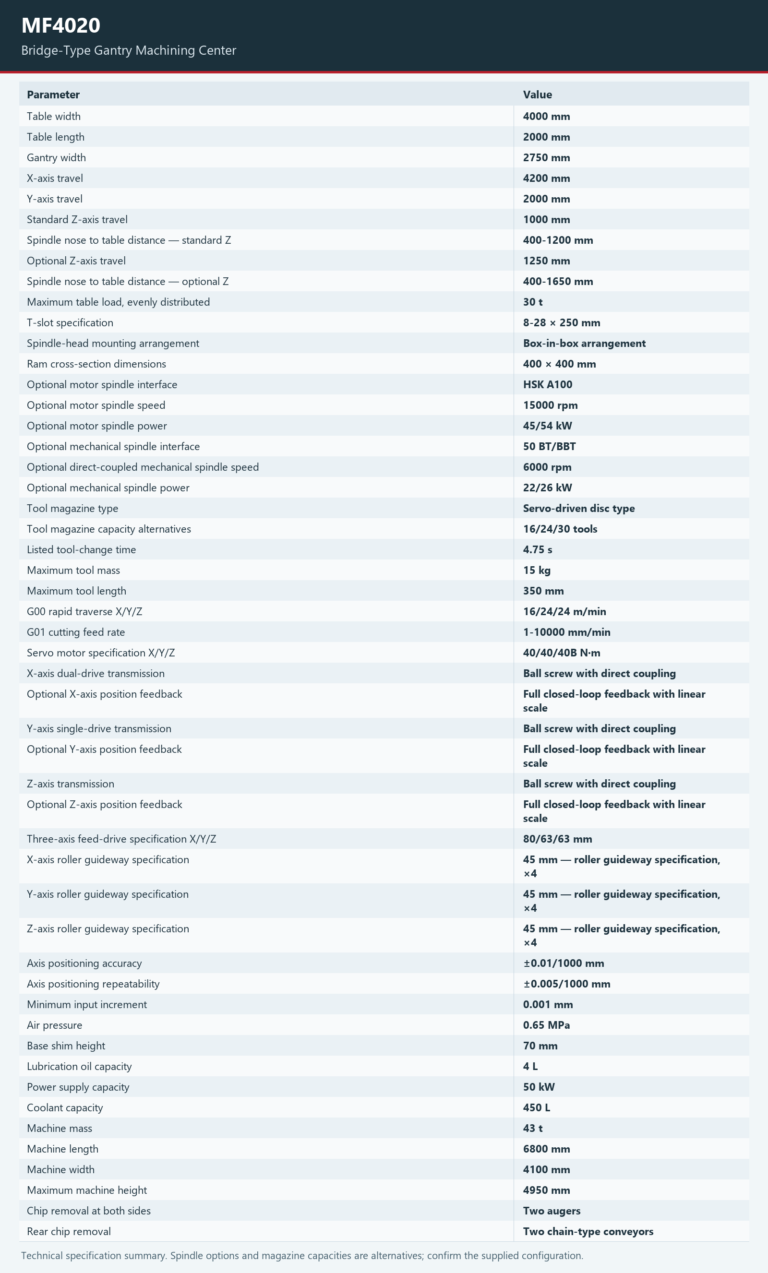
MF4020 is a bridge-type gantry machining center with a table width of 4000 mm, table length of 2000 mm and X/Y/standard-Z travels of 4200 / 2000 / 1000 mm. Its listed evenly distributed table-load limit is
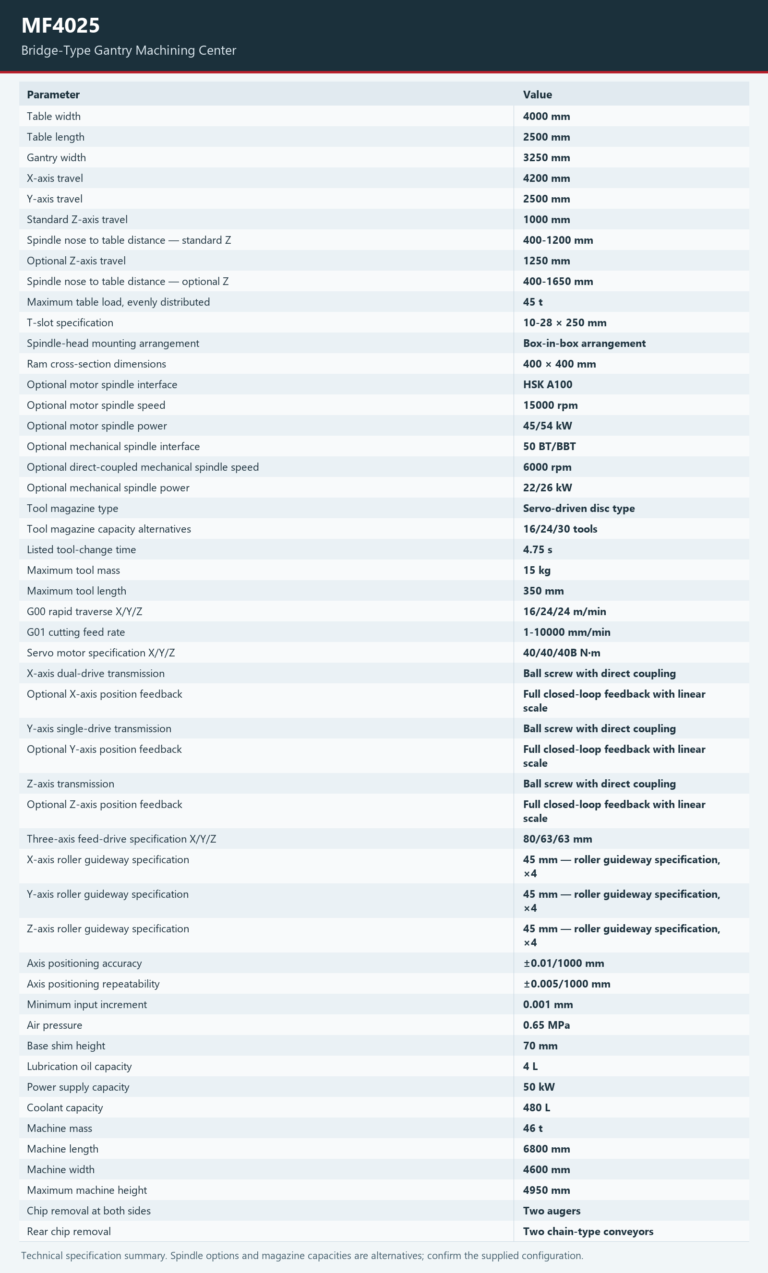
MF4025 is a bridge-type gantry machining center with a table width of 4000 mm, table length of 2500 mm and X/Y/standard-Z travels of 4200 / 2500 / 1000 mm. Its listed evenly distributed table-load limit is
MF4030 is a bridge-type gantry machining center with a table width of 4000 mm, table length of 3000 mm and X/Y/standard-Z travels of 4200 / 3200 / 1000 mm. Its listed evenly distributed table-load limit is
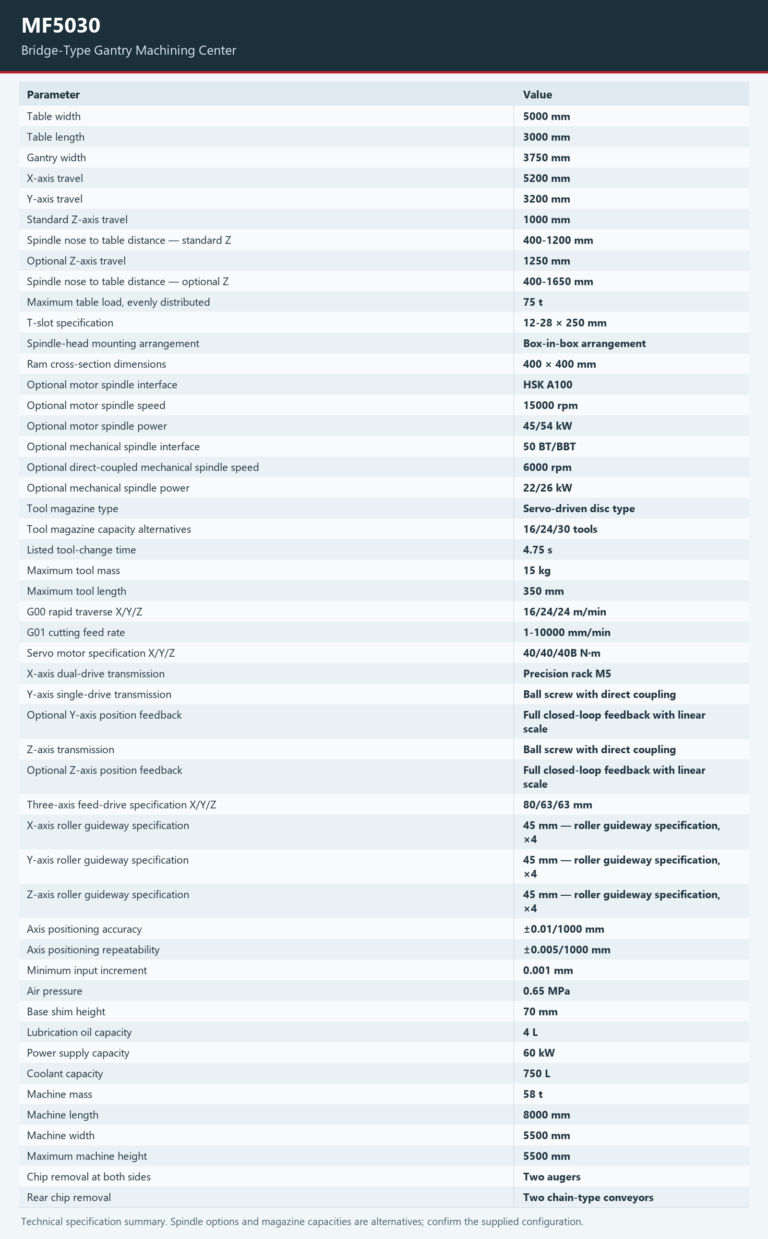
MF5030 is a bridge-type gantry machining center with a table width of 5000 mm, table length of 3000 mm and X/Y/standard-Z travels of 5200 / 3200 / 1000 mm. Its listed evenly distributed table-load limit is
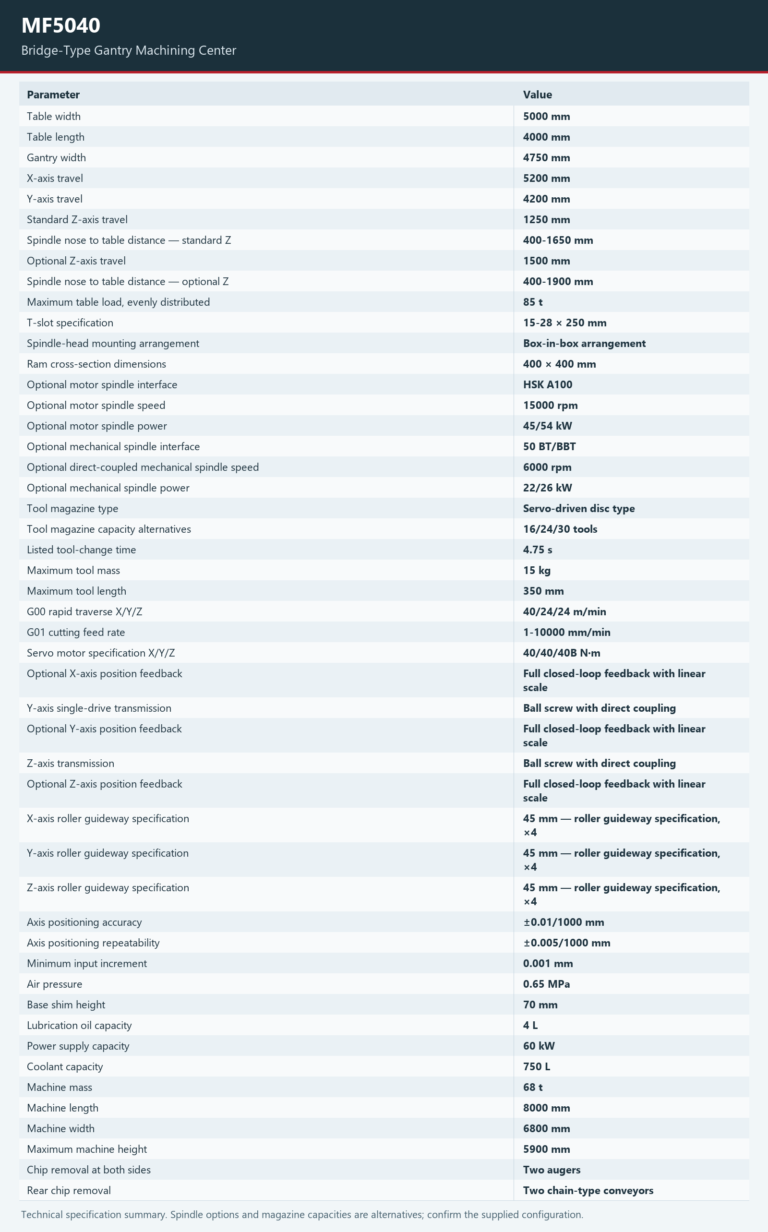
MF5040 is a bridge-type gantry machining center with a table width of 5000 mm, table length of 4000 mm and X/Y/standard-Z travels of 5200 / 4200 / 1250 mm. Its listed evenly distributed table-load limit is
MF6030 is a bridge-type gantry machining center with a table width of 6000 mm, table length of 3000 mm and X/Y/standard-Z travels of 6200 / 3200 / 1000 mm. Its listed evenly distributed table-load limit is
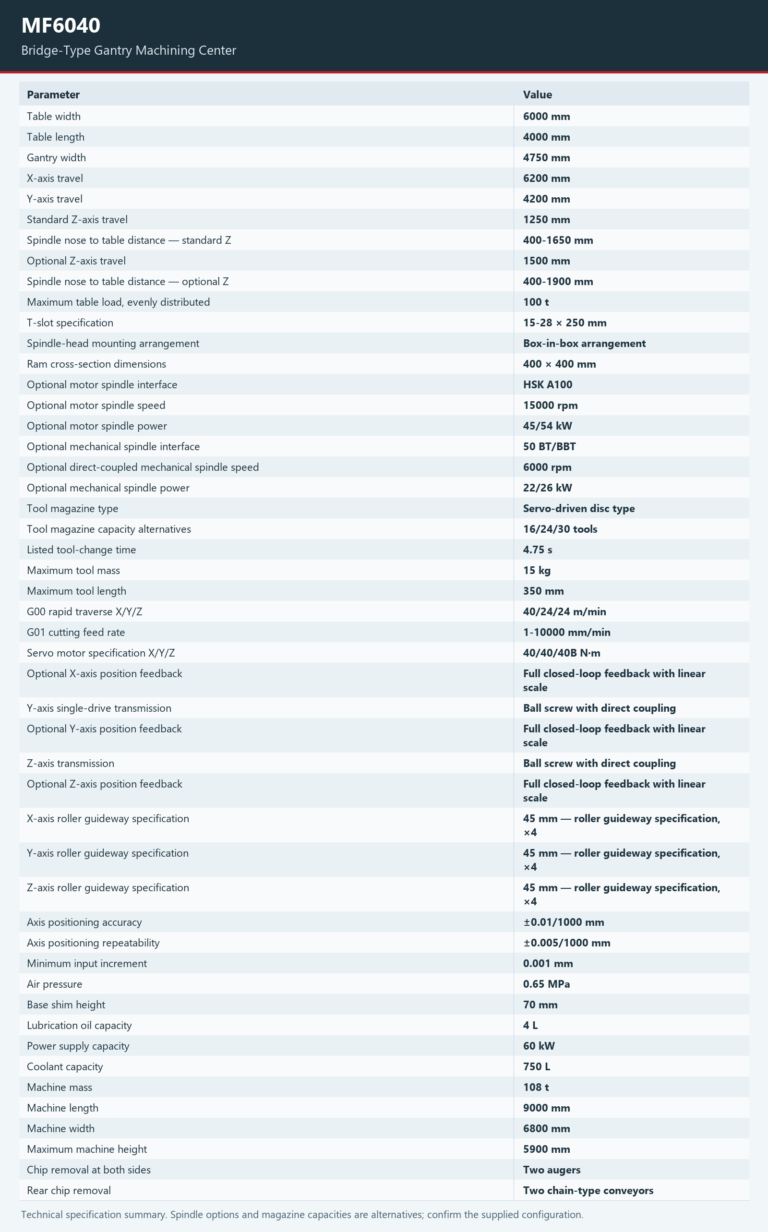
MF6040 is a bridge-type gantry machining center with a table width of 6000 mm, table length of 4000 mm and X/Y/standard-Z travels of 6200 / 4200 / 1250 mm. Its listed evenly distributed table-load limit is
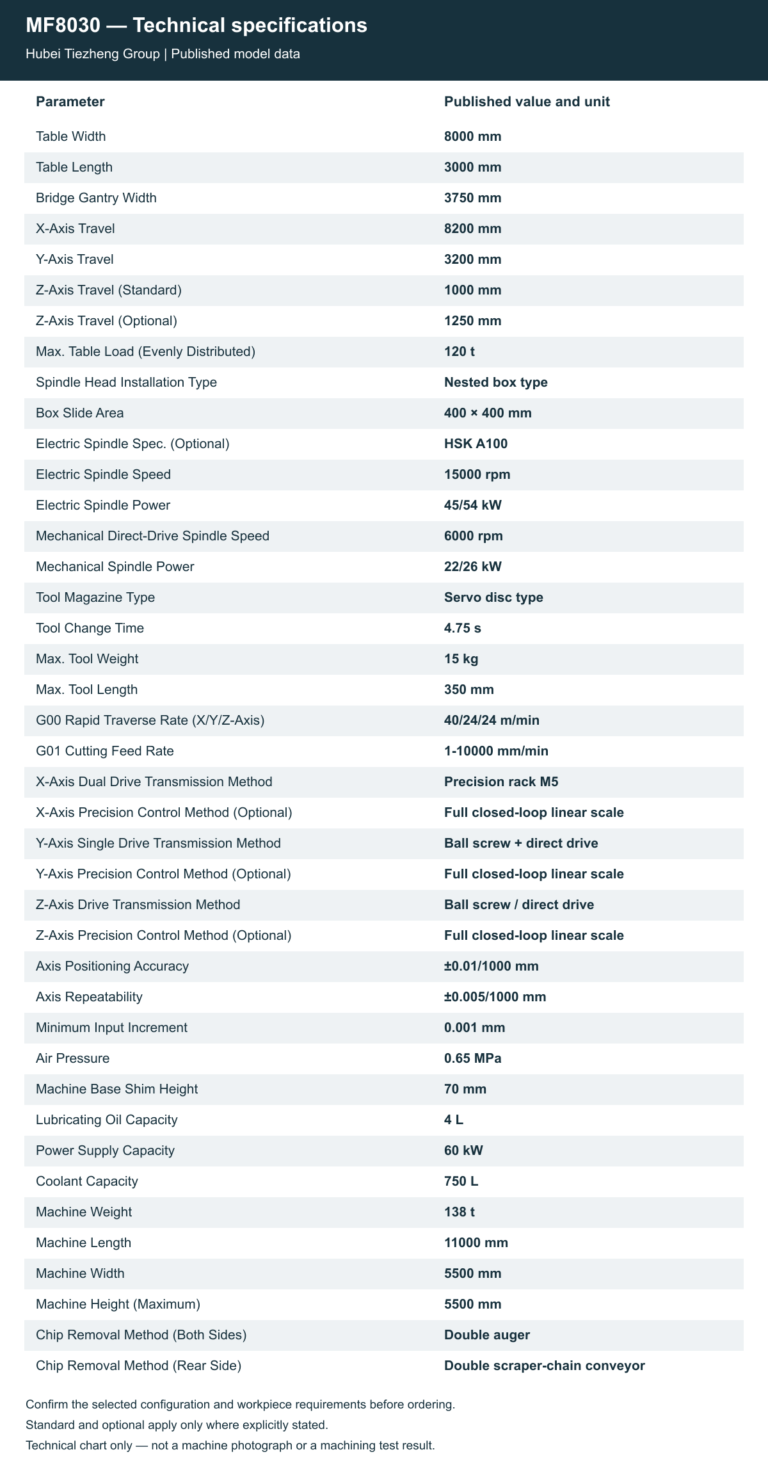
The MF8030 is listed under gantry machining centers in the Tiezheng catalogue. Table Width: 8000 mm; Table Length: 3000 mm. Published dimensions and spindle data do not approve a workpiece setup. Compare the complete specification table,
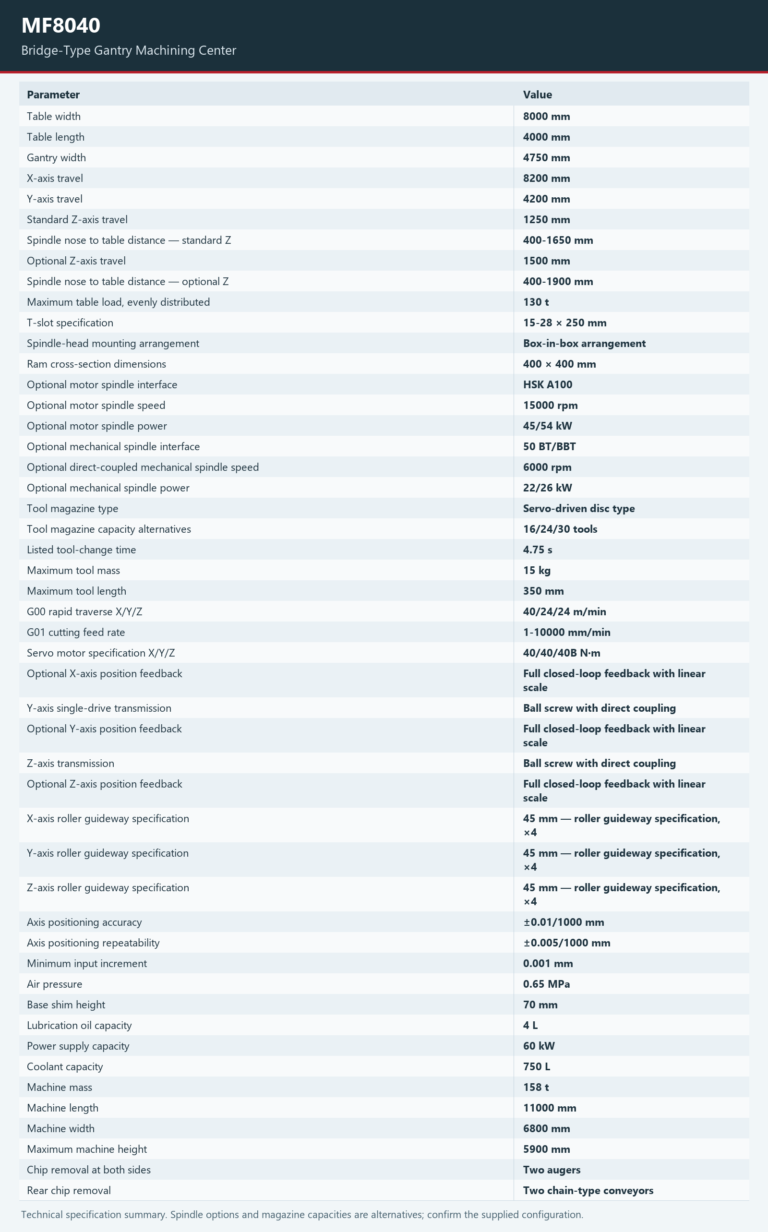
MF8040 is a bridge-type gantry machining center with a table width of 8000 mm, table length of 4000 mm and X/Y/standard-Z travels of 8200 / 4200 / 1250 mm. Its listed evenly distributed table-load limit is
The Tiezheng MB22-8030 is a gantry machining center with 8200 mm X-axis travel, 3000 mm Y-axis travel, 1000 mm Z-axis travel and 25 t worktable load. Confirm additional specifications, configuration, process requirements and delivery details through
The MC1100 is listed under gantry machining centers in the Tiezheng catalogue. Table size, X: 1100 mm; Table size, Y: 850 mm. Published dimensions and spindle data do not approve a workpiece setup. Compare the complete
The MC1300 is listed under gantry machining centers in the Tiezheng catalogue. Table size, X: 1300 mm; Table size, Y: 850 mm. Published dimensions and spindle data do not approve a workpiece setup. Compare the complete
The MC1600 is listed under gantry machining centers in the Tiezheng catalogue. Table size, X: 1300 mm; Table size, Y: 1600 mm. Published dimensions and spindle data do not approve a workpiece setup. Compare the complete
The MC2000 is listed under gantry machining centers in the Tiezheng catalogue. Table size, X: 2000 mm; Table size, Y: 1600 mm. Published dimensions and spindle data do not approve a workpiece setup. Compare the complete
The MC600 is listed under gantry machining centers in the Tiezheng catalogue. Table size, X: 500 mm; Table size, Y: 600 mm. Published dimensions and spindle data do not approve a workpiece setup. Compare the complete
The MC800 is listed under gantry machining centers in the Tiezheng catalogue. Table size, X: 800 mm; Table size, Y: 600 mm. Published dimensions and spindle data do not approve a workpiece setup. Compare the complete
The MC900 is listed under gantry machining centers in the Tiezheng catalogue. Table size, X: 900 mm; Table size, Y: 800 mm. Published dimensions and spindle data do not approve a workpiece setup. Compare the complete
The ME1100 is listed under gantry machining centers in the Tiezheng catalogue. Table size, X/Y: 1000*1000 mm; X/Y-axis travel: 1100*1100 mm. Published dimensions and spindle data do not approve a workpiece setup. Compare the complete specification
The ME2200 is listed under gantry machining centers in the Tiezheng catalogue. Table size, X/Y: 2000*2000 mm; X/Y-axis travel: 2200*2200 mm. Published dimensions and spindle data do not approve a workpiece setup. Compare the complete specification
The ME3200 is listed under gantry machining centers in the Tiezheng catalogue. Table size, X/Y: 3000*3000 mm; X/Y-axis travel: 3200*3200 mm. Published dimensions and spindle data do not approve a workpiece setup. Compare the complete specification
The ME4200 is listed under gantry machining centers in the Tiezheng catalogue. Table size, X/Y: 4000*4000 mm; X/Y-axis travel: 4200*4200 mm. Published dimensions and spindle data do not approve a workpiece setup. Compare the complete specification
The Tiezheng SFA/T2012 is a light-duty gantry machining center, also identified as SFA2012 in first-party factory footage. Published specifications list a 2000 × 1200 mm worktable, 2100/1200/550 mm X/Y/Z travel and 2230 mm gantry width. Final
The Tiezheng SMA/T2030 is a light gantry machining center with a 2000 x 3000 mm worktable, 550 mm Z-axis travel, 5 t maximum worktable load, BT40 direct-drive spindle and 12000 rpm spindle speed. Compare these specifications
The Tiezheng SVA/T10550 is a moving-column machining center documented with an 11000 x 500 mm worktable, 10500 x 550 mm X/Y travel, 550 mm standard or 700 mm optional Z travel, a standard BT40 direct-drive spindle
The Tiezheng SVA/T12550 is a moving-column machining center for application screening and a configuration-specific quotation. Contact Tiezheng for the current specification sheet and model images. Send drawings, material, part dimensions and weight, tolerances, required operations, annual
The Tiezheng SVA/T2050 is a moving-column machining center documented with a 2500 x 500 mm worktable, 2000 x 550 mm X/Y travel, 550 mm standard or 700 mm optional Z travel, a standard BT40 direct-drive spindle
The Tiezheng SVA/T2550 is a moving-column machining center documented with a 3000 x 500 mm worktable, 2500 x 550 mm X/Y travel, 550 mm standard or 700 mm optional Z travel, a standard BT40 direct-drive spindle
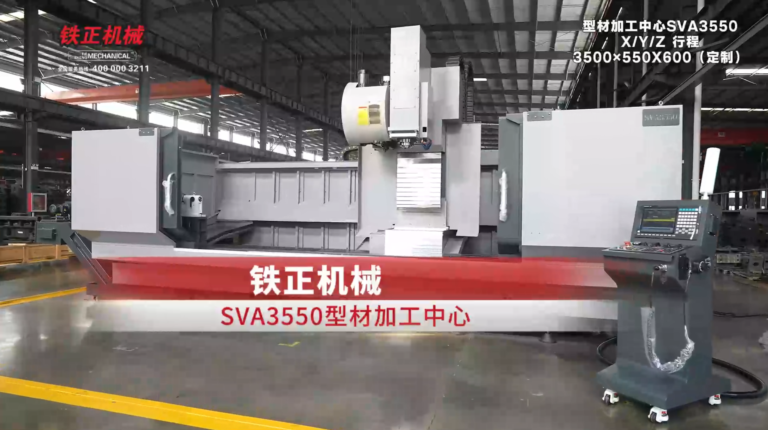
The Tiezheng SVA/T3550 is a moving-column machining center with a 4000 x 500 mm worktable, 3500 x 550 mm X/Y travel, 550 mm standard or 700 mm optional Z travel, a BT40 12000 rpm direct-drive spindle
The Tiezheng SVA/T4550 is a moving-column machining center with three factory assembly views of the T4550 machine layout. Standard specifications include a 5000 x 500 mm worktable, 4500 x 550 mm X/Y travel, 550 mm standard
The Tiezheng SVA/T6550 is a moving-column machining center documented with a 7000 x 500 mm worktable, 6500 x 550 mm X/Y travel, 550 mm standard or 700 mm optional Z travel, a standard BT40 direct-drive spindle
The Tiezheng SVA/T8550 is a moving-column machining center documented with a 9000 x 500 mm worktable, 8500 x 550 mm X/Y travel, and 550 mm Z travel. This page keeps control, spindle, tooling and optional configuration
Optional analytics helps us understand website visits and saved inquiries. Optional marketing measures advertising visits with Meta. Both stay off until you choose. Rejecting does not affect browsing or inquiries.