What is this machine used for?
What work should I discuss?
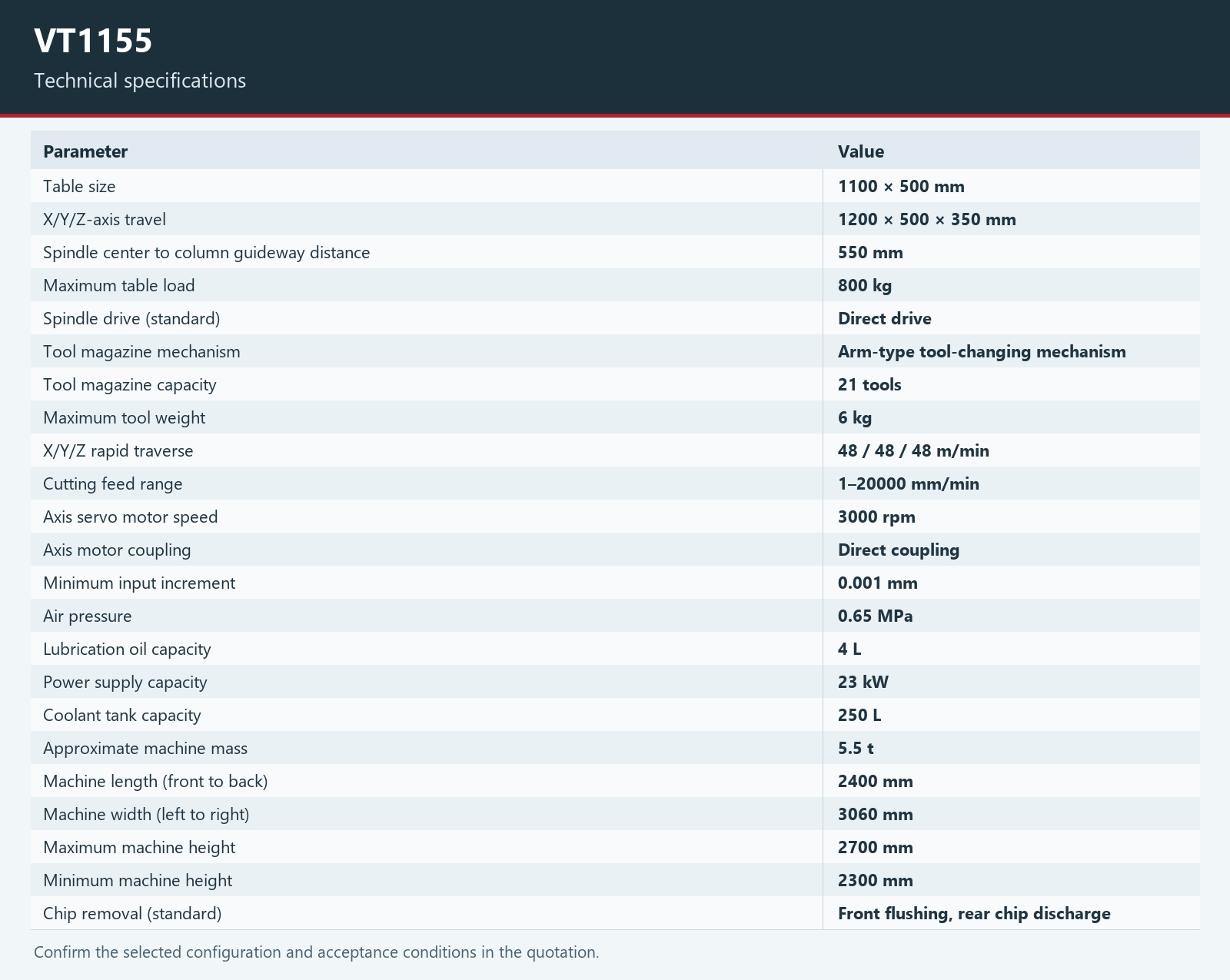
Describe the holes, threads and milled features required on your part. Give the overall dimensions, clamping faces, material grade and quantities you know. The table size, axis travels and table load are separate limits; they do not by themselves establish the usable machining envelope.
Confirm the supplied configuration
Ask engineering to confirm the spindle taper and speed, tool holders, workholding and control functions for your process. A tool magazine handles tool changes; it does not establish robotic workpiece loading or unattended production. Review fourth-axis or loading interfaces separately.
How should I read the specifications?
Rapid traverse and cutting feed are different operating values. The minimum input increment is a command value, not a guarantee of finished-part tolerance. Machine dimensions and mass do not replace a site, foundation, access or installation review.
Prepare an engineering inquiry
Start with the dimensions or operations you know. A drawing is optional for the first inquiry. Add material, quantity, important tolerances and loading preference when available. The inquiry link keeps this exact model; ask the team to confirm the configuration and delivery, installation, training and support responsibilities.
Questions before selecting this machine
Does the table load tell me that my part will fit?
No. Check the complete part, fixture, tool assembly and clearances together. Table load, table size and axis travel are separate limits.
Which spindle taper and speed will be supplied?
Confirm the spindle configuration with engineering for the exact order. Do not select a tool holder or process setting from the model name alone.
Does the 21-tool magazine include automatic part loading?
No. Tool capacity is separate from workpiece loading. Confirm any robot, loader, interfaces and guarding for the proposed configuration.
Does the minimum input increment guarantee my tolerance?
No. Finished-part tolerance depends on the setup, material, tools, process and agreed inspection conditions. Provide the critical features for review.
What information is needed for an initial inquiry?
The part or operation you need is enough to start. Add dimensions, material grade, quantities and a drawing when available; engineering can identify the next details needed.